
Police chief outlines plan to replace K-9 with Labrador teams, proposes mixed funding
Get AI-powered insights, summaries, and transcripts
Subscribe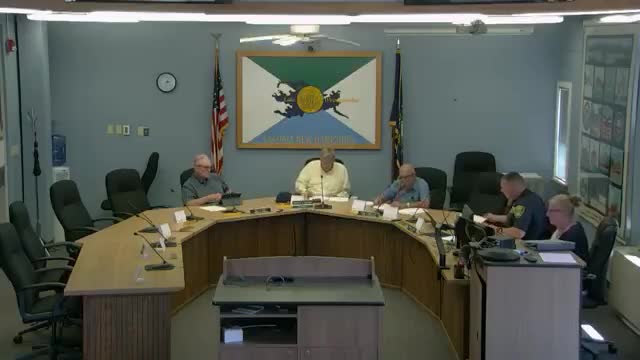
Summary
Chief Canfield said the department—s patrol dog is nearing the end of service and outlined plans to acquire two Labrador retrievers trained for tracking and explosives detection at about $25,000 per dog; funding for the replacement dog would use $10,000 from drug forfeiture funds and $15,000 from the department—s current budget, the chief said.
Chief Canfield told commissioners the department—s current canine is nearing the end of its working life, telling the panel, "he is nearing the end of his work in life. So he's got, what appears to be hip dysplasia in his hips." The chief described plans to replace the dog with Labrador retrievers trained in tracking and explosives detection and said the department will send two dogs to the same five-week training program in South Carolina so they—ll be matched to their handlers.
The chief said the department has moved away from using its previous K-9 for drug searches because of the increased presence of heroin and fentanyl and the risk to dogs. He described the Labrador as "a much friendlier dog that we can use for community presentations and community events." The department plans to buy two identical dogs to improve tracking availability and reduce off-duty callouts.
On cost, the chief said the training-and-replacement program is "$25,000 per dog." He told commissioners the first dog was funded through last year—s budget and that the additional replacement would be funded with "$10,000 from our drug forfeiture fund and then the other $15,000 to absorb that from our current budget." The chief said the department selected two handlers through a testing process and is confirming that the handlers can meet the 24-hour home-care commitment required for a K-9.
Commissioner Davis asked whether the department was "shying away from German shepherds," and the chief confirmed the planned dogs are Labrador retrievers. The chief characterized the shorter, five-week trainers— program as more schedule- and cost-efficient than earlier, longer programs the department used. The plan was discussed as a department initiative; the meeting record does not show a formal vote or an appropriation approved by the commission during this session.
The chief also noted the Labrador—s community-friendly profile and utility for tracking and presentations as reasons for the change.