
County committee approves application to tap state match for alcohol-monitoring devices for indigent DUI probationers
Get AI-powered insights, summaries, and transcripts
Subscribe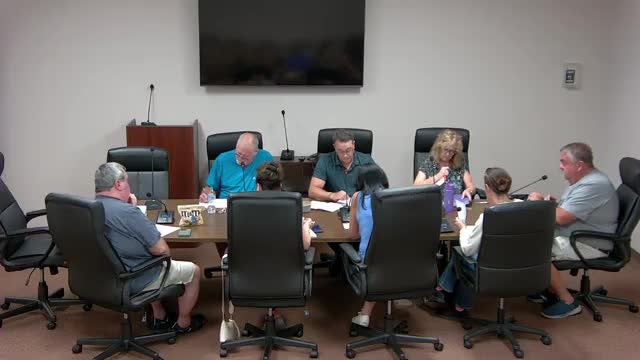
Summary
The Coffee County Budget and Finance Committee voted July 24 to let staff apply for a state matching grant to pay for court-ordered alcohol-monitoring “SCRAM” devices for indigent defendants, asking the county to commit $5,100 to unlock a $5,100 state match.
On July 24, 2025, the Coffee County Budget and Finance Committee voted to allow staff to apply for a state matching grant that would pay part of the cost of court-ordered alcohol-monitoring devices for indigent defendants who face a 90-day sobriety condition as part of probation.
The fund matters because it would let judges provide an alternative to incarcerating people who cannot afford required monitoring devices, while the county would initially commit a modest amount—$5,100—to secure a roughly equal state match for a combined fund of about $10,200.
Jenny Anthony, staff member, told the committee she received an email from a state program offering the matching funds and described how the devices are used as a probation condition for third (and subsequent) DUI convictions. Anthony said the devices most commonly used locally are SCRAM-style ankle monitors and that the county would likely see “20 people or less” use the fund in a year. She identified AMS as a vendor frequently used by probation and said vendors typically charge about $400 upfront and about $300 per month if someone pays privately; the indigent rate reviewed by the state cuts those charges roughly in half, she said, and defendants ordered to the device must still pay at least $30 per month.
Anthony said the grant is a one-to-one matching program: the county would provide $5,100 and the state would provide $5,100, producing an estimated $10,200 fund that would be drawn on as needs arise. She told the committee the money is provided up front, requires quarterly reporting, and that unused funds roll over from year to year. Anthony said she can handle the quarterly reporting but would need coordination with the probation office and courts when devices are ordered.
Committee members asked about likely use and cost. Anthony said she contacted public defender John Nickel for data; Nickel provided a count that Anthony summarized as 158 indigent DUI cases from 2022 through the present, though she cautioned not all of those would be eligible for the device and that 20 users a year would be a conservative high estimate. Anthony also said judges would determine eligibility and sign orders, and that probation staff (she named Jared as a likely point of contact) would be heavily involved in administering the program.
A motion to allow staff to apply for the grant was put forward and seconded. The committee recorded a vote approving the application; two members recorded opposition. Anthony said the application deadline was July 31 and asked only for approval to apply, not for the county to commit additional line-item budget beyond the requested $5,100 match at this time.
Discussion versus decision: committee discussion covered program mechanics (vendor fees, reporting, who qualifies, and coordination with probation and the public defender). The formal action recorded was approval to apply for the state matching grant; committee members did not adopt implementation rules or change statute-based probation requirements at the meeting.
Clarifying details from the meeting: the county asked for $5,100 in local funds to secure an equal state match; the combined fund would be about $10,200; vendor AMS was cited as a common provider; private costs cited were roughly $400 upfront and $300 per month; indigent rates discussed were roughly $200 upfront and $200 per month with the defendant responsible for a minimum $30 monthly contribution; Anthony gave a working estimate of up to 20 device users in a year but cited public defender data showing 158 indigent DUI cases since 2022 (not all eligible for this program). The application deadline cited by staff was July 31, 2025.
Proper names mentioned in the discussion include AMS (vendor), John Nickel (public defender), Jared (probation staff), Tim and Mariana (county staff referenced for paperwork), and Jenny Anthony (presenter).
Next steps noted at the meeting: staff will file the application before the stated deadline and, if awarded, set up an account to receive the state match and coordinate invoices from vendors; the county would handle quarterly reporting and roll unused funds forward into subsequent fiscal years.
Ending: The committee authorized staff to apply for the match; implementation details—including a formal grant manager and coordination with probation and the courts—were left to county staff to sort out if the grant is awarded.