
Council tables ADU zoning amendment to March after extended public comment
Get AI-powered insights, summaries, and transcripts
Subscribe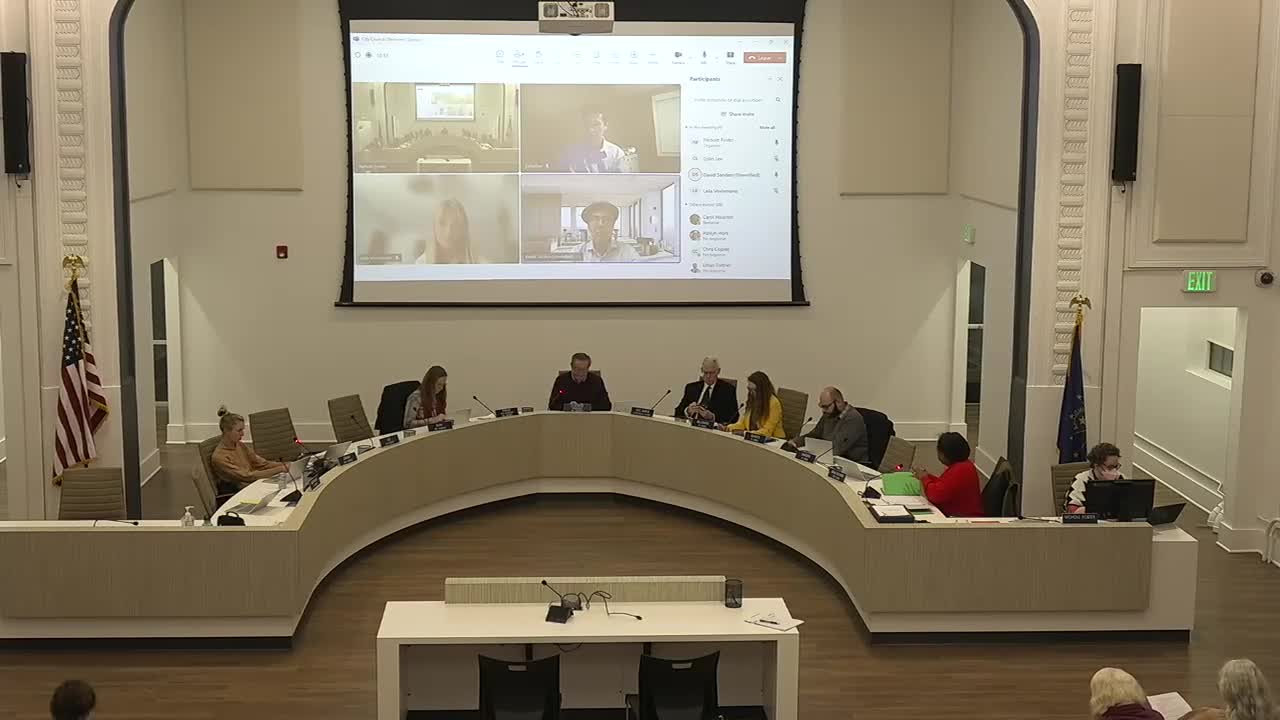
Summary
The West Lafayette City Council delayed action on Ordinance 1-20-25, an amendment to the Unified Zoning Ordinance to allow accessory dwelling units (ADUs) by right, and directed staff to hold community meetings before the March hearing.
The West Lafayette City Council on Jan. 6 voted 7–1 to table Ordinance 1-20-25, a proposed amendment to the Unified Zoning Ordinance (UZO amendment 114) that would permit accessory dwelling units (ADUs) in single-family zones, and directed staff to hold community meetings before the item returns in March.
Chad Spitzong, Building Commissioner, presented the Area Plan Commission's ADU proposal and described key provisions: an ADU is an additional dwelling unit on a lot with an existing single-family house that is incidental to the primary dwelling and must be owner occupied. The draft defines three ADU types (internal, attached and detached); sets a minimum ADU living area of 400 square feet and a maximum of 750 square feet; limits bedroom size per code (70 square feet minimum); caps detached ADUs at 750 square feet regardless of existing accessory structure size; requires plumbing to tie to the primary structure; prohibits a separate sewer tap or a new driveway cut; and requires conformance with historic preservation district regulation and primary-building setbacks. The draft makes ADUs permitted in R-1 and R-2 single-family zoning where the lot is legally conforming and meets minimum lot-width and lot-area standards (the transcript cited a 4,000-square-foot minimum for some R-1U lots).
Council discussion and public comment
Council members expressed a desire to "get it right" and to schedule community meetings after a surge of resident feedback in the 24248 hours before the meeting. Several councilors said they supported the ordinance in principle but wanted more time to hear neighbors' concerns.
Public commenters were divided. Speakers opposed to the ordinance raised concerns about increased student housing pressure, parking and traffic, enforcement capacity, loss of neighborhood character and insufficient notice to affected homeowners. Speakers in favor said ADUs can increase housing supply, help aging residents stay in place, and provide lower-cost rental options for working residents; proponents also argued owner-occupancy rules and neighborhood review can limit abuse.
Notable public comments included:
- Patty O'Callaghan (927 N. Salisbury St.) said ADUs are appropriate to increase housing supply but urged careful density management and stronger code enforcement; she opposed assigning historic-preservation review as the sole gatekeeper.
- Zachary Veil (124 Connolly St.) and other New Chauncey residents said the proposal, as written, would allow by-right densification in single-family areas and risked undermining a 2013 strategic plan that targeted densification in other parts of New Chauncey.
- Alex Beers (2400 Northwestern Ave.) and Angel Valentin (Wabash Township trustee; financial assistance director at Lafayette Urban Ministry) spoke in favor, emphasizing options for aging homeowners, graduate students and working families.
- Several long-term New Chauncey residents said they learned of the proposal only in the prior week and requested more outreach and neighborhood meetings.
Council action
A motion to table the ordinance to the March 2025 meeting passed by roll call 71 (Belisario: yes; Blanco: no; Dennis: yes; Lee: yes; Lefference: yes; Parker: yes; Sanders: yes; Betamanez: yes). The council directed staff to schedule community meetings and to return the ordinance for further consideration in March.
What the ordinance would do (as presented)
- One ADU per property; owner occupancy required for the lot. - Minimum ADU size: 400 sq. ft.; maximum living area: 750 sq. ft.; 70 sq. ft. minimum bedroom size per code. - ADUs must conform to historic-preservation district regulations where applicable. - Detached ADUs must meet setbacks and maintain a minimum 6-foot separation from the primary structure; plumbing and water must tie into the primary residence rather than creating a new tap. - ADUs permitted by right on legally conforming lots in R-1 and certain R-1U and R-2 zones (R-2 limited to properties used as single-family residences under the draft).
Next steps
Councilors said they will hold community meetings and gather neighborhood input before reintroducing Ordinance 1-20-25 at the March meeting. Staff indicated the rental-housing program and code-enforcement capacity would be considerations in implementation discussions.