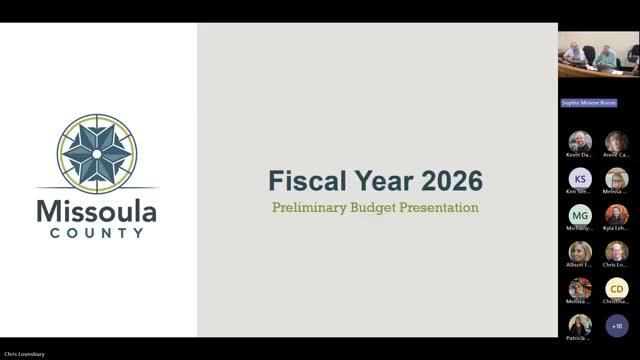
Missoula County opens public hearing on preliminary FY2026 budget, cites $5.76M in base‑budget needs
Summary
County leaders presented the preliminary FY2026 budget and opened a public hearing Wednesday, saying base‑budget increases driven by personnel, detention costs and debt service would require roughly $5.76 million in additional property‑tax funding unless certified taxable values reduce the burden.
Missoula County commissioners opened a public hearing Wednesday on the preliminary fiscal‑year 2026 budget after a presentation from Chief Administrative Officer Chris Lounsberry and Chief Financial Officer Andrew Chorney that outlined base‑budget shortfalls and department‑level increases.
Lounsberry told the board that legislative changes this year (identified in the presentation as House Bill 231 and Senate Bill 542) altered property‑tax rates and added a one‑time $400 state rebate for many primary residences, but that the county must still fund statutory services. "For every dollar that folks pay in property taxes in Missoula County, 90% of that goes directly towards performing the statutory functions that Missoula County is required to provide," Lounsberry said.
CFO Andrew Chorney outlined the county’s base‑budget increases and debt obligations. Departmental personnel and operations increases cited in the presentation included: a roughly $1.16 million proposed increase in the general fund (largely personnel), a $235,450 increase for the library, about $240,000 for extension, and an approximately $2.4 million increase at the detention center driven by the loss of state inmates (presenters cited roughly $1.66 million in lost revenue) and roughly $770,000 in personnel costs. Technology and information‑services increases of about $482,229 were also noted. Chorney said countywide operational and capital debt service totals presented were $4,583,063, county‑only CIP debt service $322,252, and other levies outside commissioners’ control about $846,750, producing an estimated additional property‑tax need of $5,762,075 to fund the base budget as presented.
Chorney and Lounsberry explained some one‑time capital items and financing: Public Works plans to finance roughly $1 million of a new crusher (the full crusher cost was described as under $2 million), the health department has an HVAC replacement estimated near $1 million, and the county continues to share capital debt service for the county/city jail facility. Lounsberry said the county will publish a full list of one‑time and ongoing enhancement requests online and that certified taxable values from the state — expected the week of Aug. 4 — will affect final decisions.
The presenters gave examples of what the base‑budget proposal would mean for homeowners at the county portion of the tax bill. For county‑wide mills alone the commissioners’ illustration showed an annual increase of $10.38 for a $100,000 home, $31.14 for a $300,000 home and $71.56 for a $600,000 home. For the items the county does not control the slide showed $1.79, $5.36 and $12.33 respectively. Lounsberry combined those figures and told the board the example for a $600,000 home would be roughly an $84 annual increase (about $7 per month) if the base‑budget funding request stands and certified values do not change the required mills.
Lounsberry and Chorney also described human‑resources pressures: the county participates in 13 collective bargaining agreements and recent negotiated raises range roughly 3%–7% as part of recruitment and retention efforts, and the county will conduct a market‑rate salary study this year. They flagged persistent staffing shortages in public safety, noting the detention facility had been reduced from nearly 19 vacancies to about seven, and roughly five vacancies remained in 911 services.
Commissioner Greer asked whether funding the base budget proposal would exhaust the county’s “banked” mills; Chorney said the proposal would use the available county‑wide mills, with some county‑only mills still available.
After the presentation a commissioner moved to open the public hearing; the motion was seconded and approved. Lounsberry said the hearing will remain open through the final‑budget adoption process, and the commissioners will consider enhancement requests and possible levy decisions after the state provides certified taxable values. Final budget adoption is scheduled for Sept. 4, 2025.
No final budget decisions were made Wednesday; the action taken was to open the statutory public hearing and invite public comment through the published schedule.