
Commission approves Community OKC church façade renovation; members debate removing historic canopy
Get AI-powered insights, summaries, and transcripts
Subscribe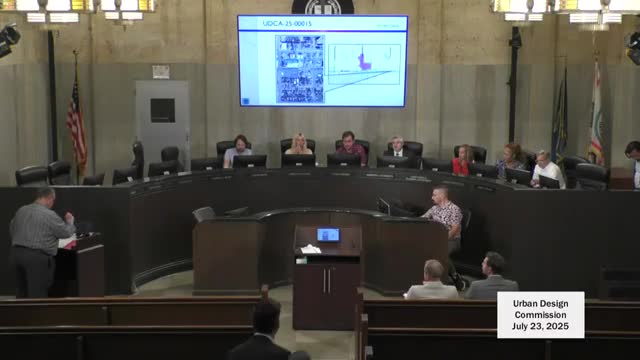
Summary
The commission approved a renovation at 417 NW 20 Third Street for the OKC Community Church that will remove a large mid‑century wooden canopy and update the storefront to better match the church property next door; commissioners debated the canopy’s visual value to the street.
The Urban Design Commission granted approval July 23 for a commercial façade renovation at 417 NW 20 Third Street, a property owned by OKC Community Church. The work will remove a large mid‑century wooden canopy and reconfigure the storefront to align visually with the church’s adjacent property.
Planning staff presented the application and concluded the proposed changes comply with the Building Conservation and Urban Design Overlay guidelines for the district, noting the renovation would make the storefront “look a lot more like the building it sits next to.”
Colin Fleckt, the project architect with Baucus Paine Architects, described the owner’s intent: “There’s the desire by the church to relate more to their existing structure, thus making it more visible for their entire operation there.” Fleckt said the design team evaluated whether the existing canopy could be reused but determined it did not align with the church’s vision and that removing it allows a lower canopy, improved pedestrian furniture and more inviting streetscape elements.
A commissioner argued the canopy is a distinctive visual marker on 20 Third Street and suggested retaining or reimagining it: “It’s actually a unique feature of 20 Third Street and when you get into the development of long swaths of shopping centers…when you start to make it all look so similar…it does take away.” The architect said the team considered alternatives and concluded removal best met the owner’s program and the applicant has exposed structural information that supports the proposed intervention.
The commission moved and seconded a standard approval motion finding the project complies with the Urban Design Overlay regulations (sections C and D in the staff report); the motion passed.
The applicant said the owner was present and available to discuss the project’s spirit and that plans call for a coffee shop‑scaled storefront with lower canopies, pedestrian furnishings and an updated streetscape to encourage pedestrian access.
The approval allows the church to proceed to permitting and construction; any work affecting historically protected elements would require additional review if such elements are later identified.