
Urban Design Commission approves Chinatown-area grocery project with conditions on signage, murals and transportation review
Get AI-powered insights, summaries, and transcripts
Subscribe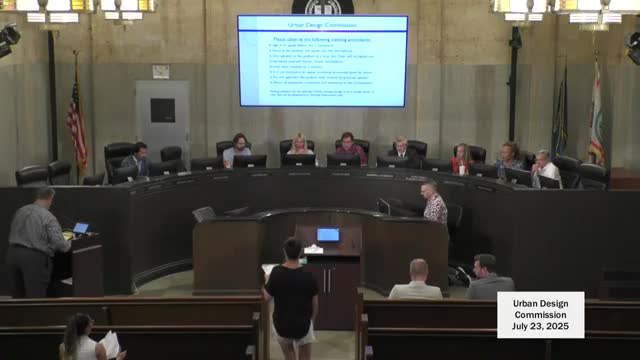
Summary
The Urban Design Commission on July 23 approved a proposed grocery store renovation at 1229 NW 20 Sixth Street, but attached conditions requiring submittal of detailed signage and mural documentation, and sign-off from the Transportation Commission and City Council.
The Urban Design Commission voted July 23 to approve a proposed grocery store project at 1229 NW 20 Sixth Street, subject to conditions requiring the applicant to submit full signage elevations and mural documentation for staff review and to secure Transportation Commission and City Council approvals for on‑street parking changes.
The project matters because it sits on Classen Boulevard in the city’s Asian District and the commission’s decision affects streetscape design, pedestrian access and how new commercial materials are introduced along a primary arterial.
Planning staff, represented at the hearing by Michael Filbert, recommended approval only with conditions. Filbert told the commission staff had received revised plans but that key details remained missing: “Without that information, in detail on the elevations with all the measurements and dimensions that are required, we’re unable at staff level to determine whether or not the signs are compliant with the code.” Filbert also raised material and entry concerns, saying the package now includes example tilt‑up concrete panels but that unfinished, exposed concrete would be “inappropriate for the site” and “more appropriate for an industrial warehouse building, as opposed to a grocery store.” He noted the Urban Design guidelines call for a pedestrian entry on the west elevation facing Classen Boulevard and flagged a risk of setting an undesirable precedent if a front access is omitted.
Holly Hunt, the applicant (Sam Gresham Architects), said the team has revised the scheme to add landscaping, benches, murals and additional windows and that the proposed tilt‑up panels will have a finish. “It looks exactly like EIFS. It is a fine, almost pebble finish,” Hunt said, adding that the owner is willing to apply paint or a stucco‑type finish if necessary: “It’s a material we can paint, certainly.” She defended the lack of a Classen Street customer entry as a functional choice, saying refrigerated fixtures and store operations make a west entry a security and operational concern and that the design includes other egress doors.
Commission discussion acknowledged the applicant’s changes while echoing staff’s two main concerns: material finish and the absence of a pedestrian entrance on Classen Boulevard. One commissioner described the latest drawings as marked improvements but said the west elevation still “feels like the back of the building.” Another commissioner urged care on material consistency, noting tilt‑up panels can vary by pour and suggested a finish coat if variation is pronounced.
The commission approved a motion that included standard language finding the project complies with the Urban Design Overlay standards, and the following conditions: the applicant must submit elevations showing sizes, dimensions and locations of all proposed signage and submit any mural/artwork documentation to staff for Certificate of Approval review before release of the COA; on‑street parking and ADA stalls on NW 20 Sixth and NW 20 Seventh are subject to approval by the Traffic Transportation Commission and the City Council; and if subsequent submittals materially differ from the approved conceptual materials, the matter will return to the commission for further review. Filbert noted the maximum aggregate signage allowed on the building is calculated by wall area percentage and that the total building maximum is 400 square feet, which could require sign reductions when measured precisely.
The conditions were moved by Commissioner (speaker 2) and seconded by Commissioner (speaker 4); the motion passed.
Less central details: the applicant said the existing parking lot and existing grocery store will remain in service during the phased work, and the owner intends to develop additional retail tenant space in the adjacent building after construction of the new grocery store. Filbert reminded the commission that final permitting will include coordination with traffic and council reviews.
Speakers quoted or cited in this article are those who spoke on this agenda item during the July 23 meeting and are listed in the article’s speaker section.
Looking ahead, staff will review the required signage elevations and mural documentation; if those submittals show noncompliance or substantial deviation from materials shown at the hearing, the project will return to the Urban Design Commission for further action.