
Oklahoma City Human Rights Commission hears 1-hour primer on Americans with Disabilities Act
Get AI-powered insights, summaries, and transcripts
Subscribe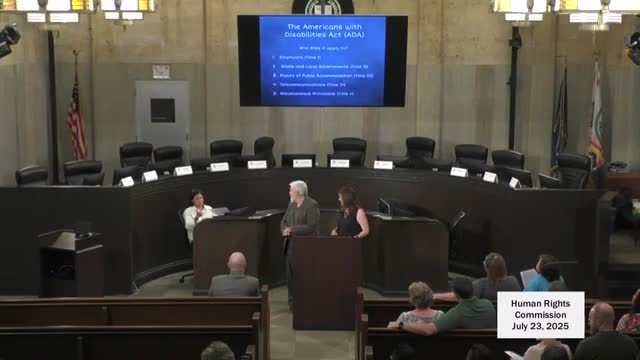
Summary
Attorneys from the Oklahoma Disability Law Center and the city’s new ADA coordinator gave a one-hour educational presentation to the Human Rights Commission covering who the ADA protects, title-by-title obligations, reasonable modifications, effective communication, architectural accessibility standards and enforcement options.
The Oklahoma City Human Rights Commission on Tuesday received a one-hour educational presentation on the Americans with Disabilities Act from attorneys at the Oklahoma Disability Law Center and the city’s newly appointed ADA coordinator. Joy Turner, director of investigation and monitoring at the Oklahoma Disability Law Center, summarized the statute’s basics: “The ADA is a federal civil rights law that prohibits discrimination against individuals with disabilities. It guarantees that individuals with disabilities have the same opportunity as other individuals.” Turner and colleague Brian Wilkerson explained the ADA’s five titles and who is covered under each, and they described the three legal ways a person can qualify as having a disability under the statute: a current impairment, a record of impairment or being “regarded as” having an impairment. The presenters reviewed obligations for state and local governments under Title II — including designation of an ADA coordinator for public entities with 50 or more employees, publication of a grievance procedure and providing programs “in the most integrated setting appropriate.” Turner cited the U.S. Supreme Court’s 1999 Olmstead ruling as central to the integration mandate and described examples such as contracting for community-integrated employment instead of segregated “sheltered workshops.” The session also covered Title III duties for private businesses and nonprofits acting as places of public accommodation. Wilkerson described typical accommodations and auxiliary aids — from service animals and physical access routes to ASL interpreters and accessible web content — and emphasized that entities must provide reasonable modifications unless doing so would cause a fundamental alteration or an undue financial or administrative burden. Both attorneys discussed remedies and enforcement. Turner noted that private parties may file complaints with the U.S. Department of Justice (within 180 days of the alleged act), and she described how injunctive relief — court orders requiring modifications or auxiliary aids — can be obtained. Wilkerson summarized litigation in which his office secured injunctive relief and streaming closed-captioning and ASL access for state legislative proceedings following a federal settlement. Scott Hodgdon, the City of Oklahoma City’s ADA coordinator and a right-of-way specialist in Public Works, outlined how the city implements accessibility in public projects and building review. Hodgdon described use of PROWAG (Public Right of Way Accessibility Guidelines) for sidewalks and ramps, contractor ADA training developed with Oklahoma City Community College, and the city’s grievance procedure and online complaint form. He also showed before-and-after field examples of accessible ramps, crosswalks and transit stops and said contractors are now required to complete ADA certification for city paving work. Panelists answered a brief public question about sidewalk upgrades and noted that sidewalk repairs are often a resident responsibility but that the city also pursues capital projects (including a 2025 general obligation bond process) that can include sidewalks. Turner highlighted a recent client case in which airport curbside assistance and website accessibility were resolved through administrative grievance and coordination with the airport IT staff and airlines. The presentation concluded with a reminder that the U.S. Department of Justice has issued final accessibility rules for government websites and mobile apps and that the presenters said Oklahoma City and the state must come into compliance by April 2026. The educational program was provided at the start of the commission meeting; no policy votes or directives were taken as part of the presentation.