
Planning commission backs rezoning for small unmanned data center after residents raise water, noise and expansion concerns
Get AI-powered insights, summaries, and transcripts
Subscribe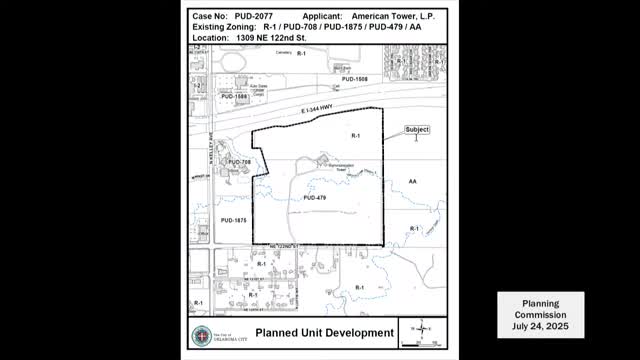
Summary
The Planning Commission voted to recommend approval of PUD 2077 for a small, unmanned data center at Northeast 120 Second Street with technical evaluations that add a limited communications use, require generator restrictions and set large setbacks after neighbors expressed concerns about water use, noise and possible future expansion.
The City of Oklahoma City Planning Commission on July 24 recommended approval to City Council of PUD 2077, a rezoning request to allow a small, unmanned data center on a parcel at Northeast 120 Second Street. Commissioners attached technical evaluations that add a limited communications use, require that generators be restricted to emergency use with monthly testing limited to weekdays, and set building setbacks from nearby streets and property lines.
The proposal was presented by David Box, who identified himself as representing the applicant. Box described the facility as “a very low scale building that will be unmanned” and said the project “doesn't generate any traffic” and uses a closed-loop cooling system for the equipment.
Neighbors and residents raised questions during public comment about noise, water use and the potential for future expansion. “We don't want our water contaminated. We don't want anybody else to be able to use our water,” said Cali Capron, a nearby resident, describing wells and septic systems used by houses near the site. Another resident, Donna Capron, urged commissioners to require limits on expansion and outdoor mechanical equipment near homes.
City utilities staff said the development will be served by public water and sewer lines and that the building’s cooling will be a closed-loop system. Dustin Seager of the utilities department said, “They will not be utilizing the public water for the cooling of the data center. We will be obligated to extend the water and sewer when we get our building permit because it's in range, but the usage of it of both the sewer and the water will be absolutely minimal.”
Commissioners pressed for protections for neighbors. As read into the record and adopted as technical evaluations, the commission added a permitting condition to record the limited commercial use unit (8300.29, communication services limited) tied specifically to data-center operations; required that generators be used only for emergencies and that routine testing of generators occur only during weekdays between 8 a.m. and 5 p.m.; and set setbacks of 150 feet from Northeast 120 Second Street, 1,000 feet from the west property line and 600 feet from the east property line. The commission also required that outdoor equipment or other “noise-generating outdoor components” be located on the north side of the building, away from the nearest residences.
Commissioners and staff said the size and configuration of the site, including an existing radio tower and its fall radius, constrained where buildings could be placed and limited the site’s practical ability to expand. Box said the tower footprint and other site constraints make large future expansion unlikely at this location.
Action: The Planning Commission voted to recommend approval to City Council of PUD 2077 with the technical evaluations described above. The item will go to City Council for final action.
Why it matters: Residents neighboring the site rely on private wells and septic systems; questions about water use and audible noise from cooling and generator equipment were the central concerns. The commission’s technical evaluations are intended to limit routine generator testing and to set setbacks and equipment placement to reduce impacts on nearby homes.
What’s next: The applicant will pursue City Council review of PUD 2077. The technical evaluations adopted by the commission will be part of the record at council and guide final permitting and site-plan review if the rezoning is approved.