Get Full Government Meeting Transcripts, Videos, & Alerts Forever!
Get email alerts on the Housing Policy Reform topic
No spam. Unsubscribe anytime.
Urban Leaders fellows propose incremental zoning changes, faith‑based development and ADU reforms to ease Tulsa housing shortage
Summary
Urban Leaders Fellowship presenters recommended small, high‑impact policy changes — encouraging housing on faith‑based land through opt‑in overlays and expanding accessory dwelling units (ADUs) by right in selected residential zones — to help close Tulsa’s estimated 13,000‑unit housing gap.
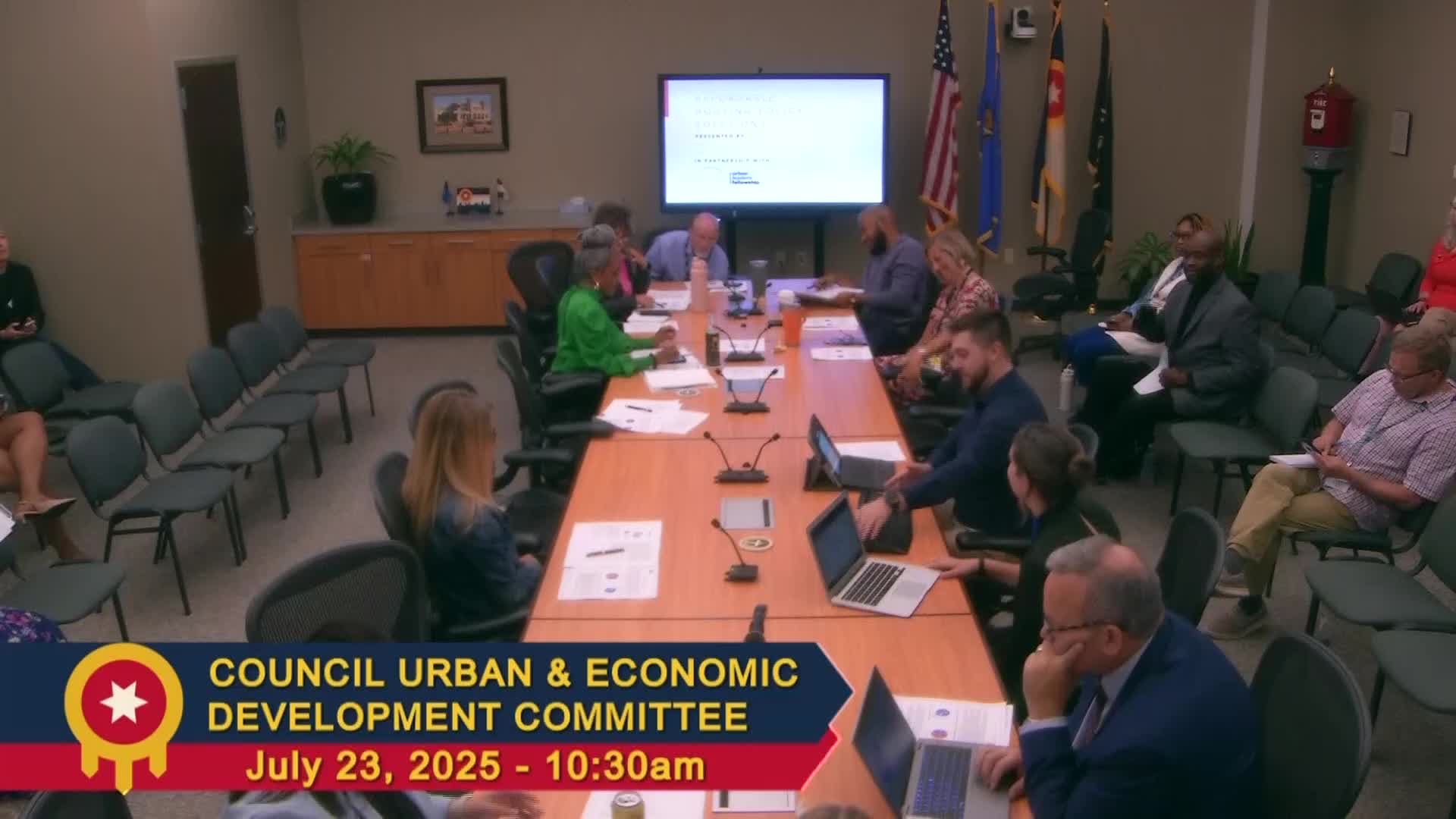
At the July 23 meeting of the City of Tulsa’s Urban Economic Development committee, fellows from the Urban Leaders Fellowship presented policy recommendations aimed at increasing housing supply through targeted, incremental zoning reforms.
Leah and Jack (fellows) described the city’s housing gap — presented in meeting materials as about 13,000 units — and urged a strategy of “high impact incremental steps” rather than sweeping code rewrites. They highlighted two primary recommendations: create an opt‑in zoning overlay and tailored permitting incentives to enable faith‑based organizations (FBOs) to develop affordable housing on church and religious organization land; and make accessory dwelling units (ADUs) allowed by right in more residential zones where demand already exists.
Presenters said Tulsa has more than 2,000 acres of land owned by religious organizations, much of it in single‑family zones, and that some local churches have already signaled interest in redevelopment. As one potential tool, presenters suggested an opt‑in overlay for faith‑based organizations that choose to pursue housing development, with code and building requirements developed with the planning office and the congregation. They cited recent municipal examples and noted federal and state proposals such as the “Yes in God’s Backyard” concept as part of a national conversation.
On ADUs, fellows showed city data indicating many residents currently seek special exceptions to build ADUs; over the 12 months cited, 20 cases resulted in 32 board of adjustment agenda items and accounted for about 15% of that board’s caseload. Presenters recommended allowing ADUs by right in selected residential categories (for example, RS‑3 and denser categories) to reduce time and cost for applicants and the board of adjustment.
Councilors raised implementation questions including community engagement to address local opposition (NIMBYism), infrastructure constraints (utilities and streets), and faith‑based delivery models and potential conditions attached to some nonprofit providers. Presenters and councilors referenced existing local pilot projects (tiny home village, Nehemiah/cottage developments) and asked for more granular maps of candidate parcels to support neighborhood‑led planning.
The item was a presentation and discussion; no formal action or vote was recorded in the transcript.