Get Full Government Meeting Transcripts, Videos, & Alerts Forever!
Get email alerts on the Housing Policy topic
No spam. Unsubscribe anytime.
Urban Leaders Fellows Urge ‘‘Incremental, High‑Impact’’ Zoning Changes to Close Tulsa’s Housing Gap
Summary
Fellows from the Urban Leaders Fellowship presented research showing a 13,000‑unit housing gap in Tulsa and recommended incremental policy changes — including enabling faith‑based organizations to develop affordable housing and expanding accessory dwelling unit (ADU) allowances — to speed housing supply increases.
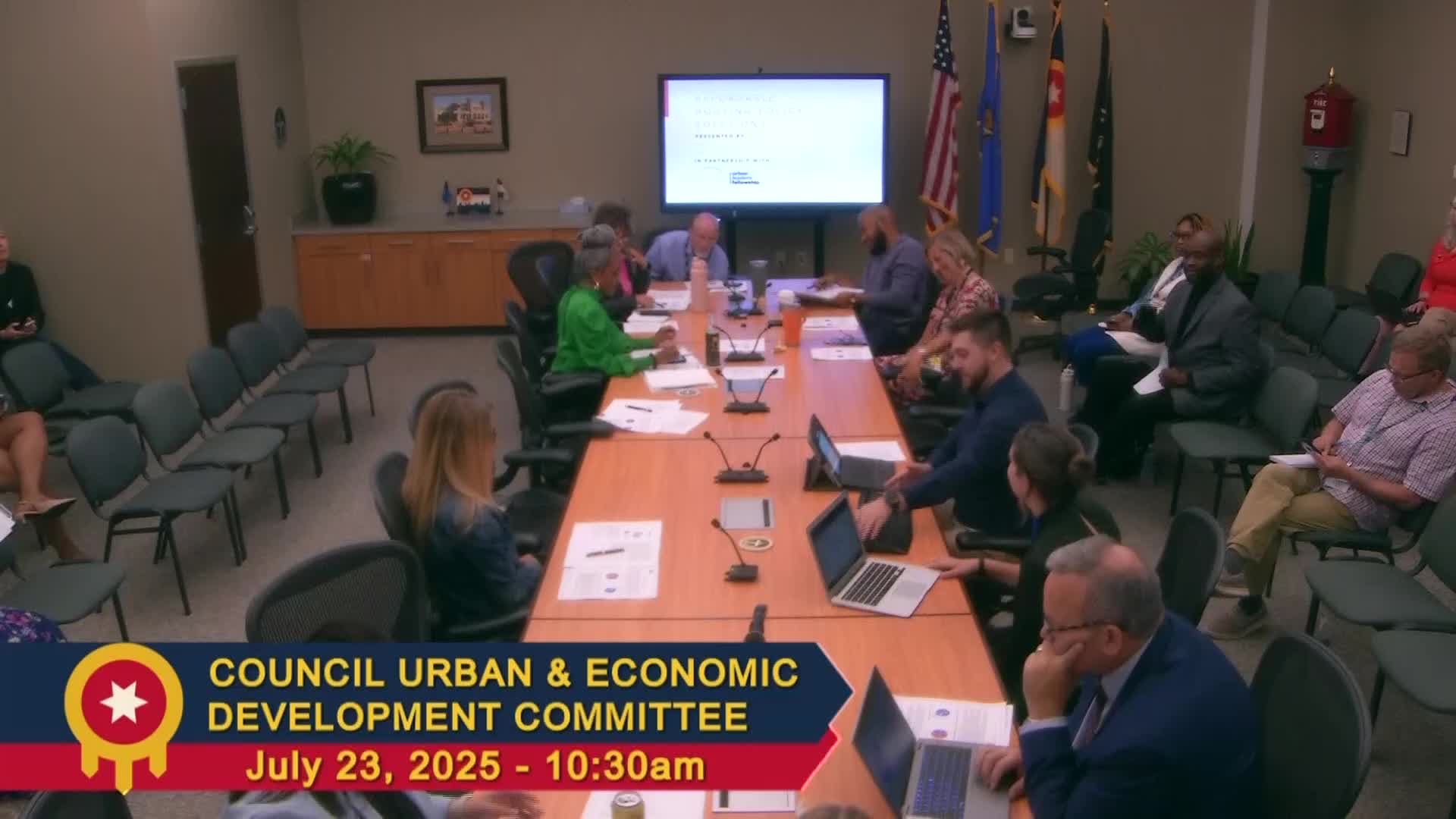
Fellows from the Urban Leaders Fellowship presented a seven‑week policy study to the committee, summarizing local housing capacity data and proposing two incremental zoning reforms intended to accelerate housing production.
The fellows said Tulsa faces a roughly 13,000‑unit shortfall and estimated the city needs to produce about 460 additional homes per year to close the gap. They showed city data indicating most vacant residential land is zoned for single‑family development and that parcels suitable for “missing‑middle” multifamily housing represent a small share of available acreage.
As practical steps, the fellows recommended (1) a tailored zoning overlay or opt‑in pathway to allow faith‑based organizations (churches, temples, mosques, etc.) to develop affordable housing on institution‑owned land, citing examples in other cities and noting more than 2,000 acres of religious‑organization‑owned land in Tulsa; and (2) expanding the by‑right allowance for ADUs in targeted residential zones to reduce the number of special‑exception requests processed by the Board of Adjustment. The presentation noted 20 ADU special‑exception cases were filed from June 2024 to June 2025 and that such requests represented about 15% of the board’s caseload over that period.
The fellows cited South Bend, Indiana, as a case where incremental, community‑led zoning reform yielded new infill units and contrasted it with Austin’s CodeNext process, which was halted after litigation. They argued that smaller, community‑oriented changes are less likely to invite litigation and more likely to produce timely results.
Councilors asked about community engagement and how to address anticipated neighborhood opposition (‘‘NIMBY’’). Fellows and several councilors discussed examples in Tulsa — including projects led by nonprofits and faith groups — and emphasized that neighborhood‑level outreach, door‑to‑door engagement and careful tailoring of overlay standards would be necessary to build local support.
One councilor raised equity concerns about faith‑based housing, asking how to ensure access for people of varied faiths or no faith and how to avoid conditioned services tied to a particular religion; the presentation team acknowledged those concerns and recommended that any program include protections ensuring nondiscriminatory access and guardrails around mandatory religious programming.
Fellows offered to provide maps and further detail to councilors; several councilors asked for a neighborhood‑level map of parcels identified as suitable for missing‑middle development so districts could prioritize community‑led pilot projects. The item was for discussion only; no formal action was taken.