
Surveillance board backs immediate use of LiveView mobile towers under temporary San Francisco policy
Get AI-powered insights, summaries, and transcripts
Subscribe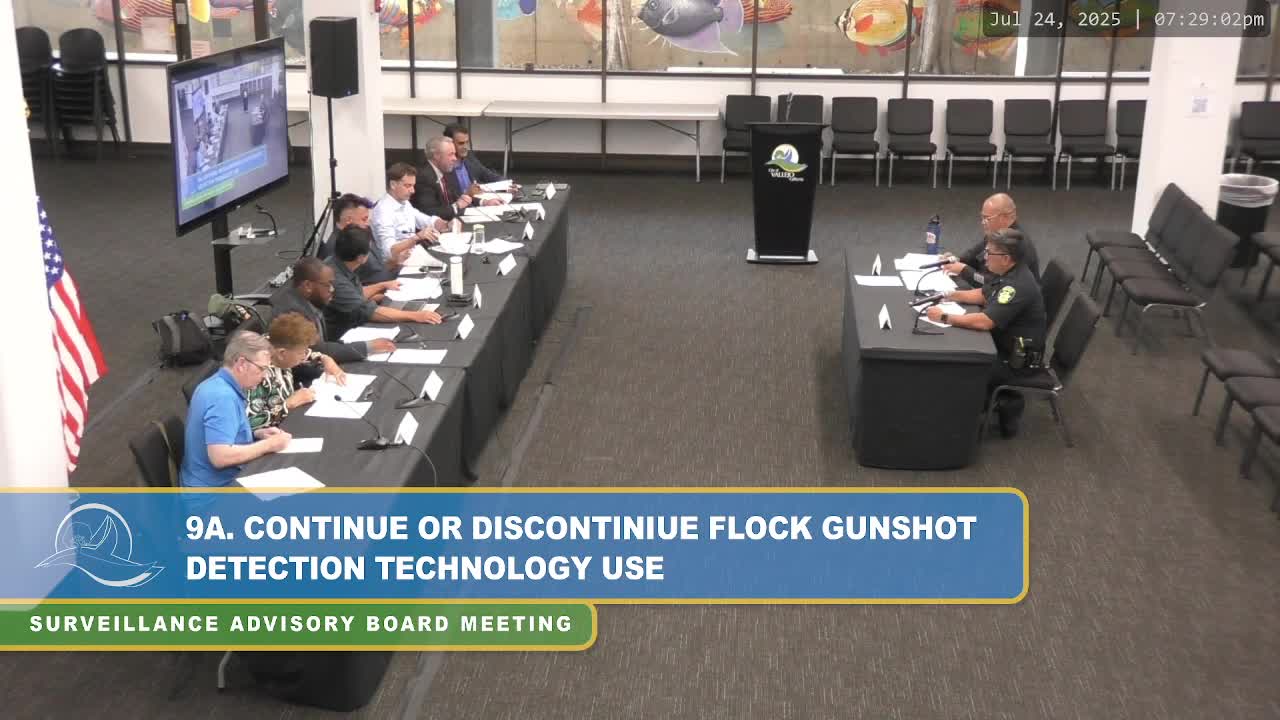
Summary
The board approved deployment of LiveView (LVT) mobile security towers and asked the police department to adopt San Francisco’s mobile-tower policy as an interim standard while the board forms an ad hoc committee to draft a Vallejo-specific usage policy.
The Vallejo Surveillance Advisory Board voted unanimously on July 21 to permit the Vallejo Police Department to proceed with procuring LiveView Technology (LVT) mobile security towers for short-term deployment and to use the San Francisco Police Department’s mobile tower policy as a temporary framework while the board develops a local policy.
Captain Batista and vendor representatives from LiveView Technology presented LVT’s mobile tower capabilities, including 24/7 video recording, thermal cameras, a 32× optical zoom PTZ, floodlights, strobe lights and a two-way speaker for “talk down” warnings. LVT representatives said video retention is a default 30 days, the units do not record audio, and video storage is routed to Amazon Web Services with primary storage in US West (Oregon) and secondary options in US East (North Virginia and Ohio). LVT said its platform is SOC 2 Type II audited and that the company can supply security and compliance documentation under an NDA; the company also offers a third‑party alert-monitoring service that the department intends to use.
Board members and the city attorney asked detailed questions about data security, sub‑processors, retention, access logs and whether third-party monitoring uses non‑U.S. personnel. LVT representatives said they will provide a list of processors/subprocessors, produce SOC 2 documentation under an NDA, and stated that third‑party monitoring would not be done by non‑U.S. residents in Vallejo’s case. LVT said its units run NDAA‑compliant cameras for municipal deployments, that default video retention is 30 days, and that footage overwritten after 30 days is not retained unless pulled into evidence. LVT stated it does not use customer video for AI training without explicit release.
The department told the board the towers were directed by the July 1 city council special meeting as urgent short‑term measures to deter summertime violence in hotspot areas (the department cited several recent shooting incidents in the Country Club Crest area and said at least two towers were scheduled for delivery the next day). Staff said the vendor selection was expedited after a survey of units already deployed in Vallejo’s commercial corridors found a preponderance of LVT units in use by private parties.
Board members requested several compliance and operational artifacts before full city deployment: a vendor processor/subprocessor inventory and physical storage locations; copies of LVT’s SOC 2 Type II and penetration‑testing reports; written post‑orders for how third‑party monitors will respond to alerts; a clear written memorandum of understanding for retailers or private owners to share LVT camera feeds with the police department; documentation that the units will not perform facial recognition; and a draft city policy that restricts uses and access. The board also requested monthly usage logs that show alerts, login/access logs and dispositions tied to CAD/incident numbers where possible.
The board voted to proceed with procurement under the temporary San Francisco policy and asked staff to form an ad hoc committee to draft a Vallejo mobile-tower usage policy. Board Members Stewart, Cohen Thompson and Board Member Bros volunteered to serve on the ad hoc committee (subcommittee membership is limited to less than a quorum). The municipal city attorney confirmed the board may recommend policy and that the city council retains authority over procurement.
Ending: The board’s motion authorizes department procurement activity to continue and sets conditions for policy work, documentation, and ongoing reporting. The board emphasized the need for transparency, processor inventories, and a local usage policy to be drafted by the ad hoc committee before any longer-term, city-funded deployment.