
Surveillance board approves continued Flock Raven use while demanding police performance data
Get AI-powered insights, summaries, and transcripts
Subscribe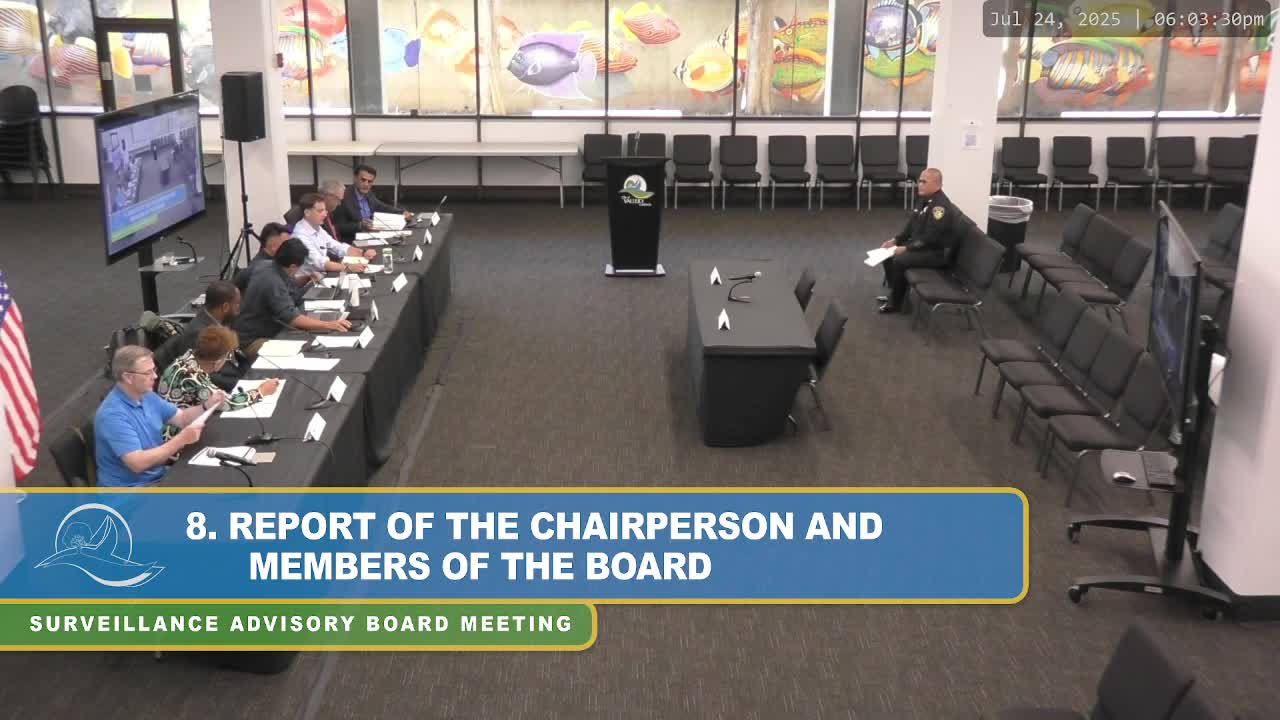
Summary
The Vallejo Surveillance Advisory Board voted to allow the police department to proceed with procuring the Flock Raven gunshot-detection system while requiring the department to provide evaluative metrics and hold a special meeting in August to review results and methodology.
The Vallejo Surveillance Advisory Board voted 4–2 on July 21 to recommend that the police department proceed toward procuring the Flock Raven gunshot-detection system while the board receives additional evaluative data and holds a special meeting in August to review the department’s metrics.
The vote followed a lengthy presentation by Captain Batista of the Vallejo Police Department and sustained questioning from board members about how the department plans to measure the system’s effectiveness beyond anecdotal cases. Captain Batista described four cases where Raven alerts helped officers locate victims or suspects and said the department views Raven as a “reactive” tool that supplements existing tactics. “Raven will give you an approximate, very good location to where [a shooting] actually occurred,” Captain Batista told the board.
Board members pressed for quantifiable performance metrics. Board Member Stewart asked for comparisons between a baseline period before the beta test and the year of Raven testing, including response times, arrests stemming from Raven alerts and the number of Raven alerts that resulted in no corroborating evidence. Board Member Russell Owen emphasized the need for security documentation and measurement plans; several members expressed concern that Raven coverage is not citywide and that placement bias (Raven units placed where gun violence is already high) could skew analyses.
City staff said funding sources identified for procurement include Measure P and other department funds; staff also said the department has begun beta testing and will request a time-limited extension of the vendor’s free beta if needed to allow the board’s review. The board’s passed motion allows the department to continue procurement work with the vendor while requiring the police department to deliver a written assessment of metrics the department will use to judge Raven’s effectiveness and to present that assessment at an August special meeting of the board. If the board, after reviewing the requested evaluation, recommends against procurement, that recommendation will be transmitted to the city council for consideration.
The board’s discussion recalled the body’s 2022 deliberations: the staff report in the packet notes the board did not endorse Raven then and that the city council allowed a free beta to proceed. Several board members said the current council and the previous council are different bodies and the board’s recommendation should still be recorded for city council consideration.
The motion that passed was moved by Board Member Stewart and seconded (second not specified in the transcript). The roll call on the final, conditional motion recorded these votes: Russell Owen — No; Cohen Thompson — Yes; Stewart — Yes; Chair Lee — Yes; Vice Chair Moreno — No; Board Member Ross — Yes. The motion carried, 4–2.
Board members specified the types of data they expect in the department’s follow-up: (1) a one-year comparison of pre‑Raven and Raven-era incidents for the same calendar period, (2) response time statistics for incidents with Raven alerts versus incidents without Raven alerts, (3) counts of arrests or case leads attributable to Raven alerts, (4) a log correlating computer-aided-dispatch incident numbers with Raven alerts, and (5) documentation of how dispatch integrates Raven alerts into incident records. The board also asked staff to provide the police department’s list of investigative metrics and to confirm whether a crime analyst is available to perform the requested analyses.
The board asked that Captain Batista request a short extension of the vendor’s free beta period if needed to avoid a lapse in coverage while procurement paperwork is completed. The department indicated it will continue to publish Raven usage reports on its regular agenda items and will return with the requested statistical analysis at the special August meeting.
The board’s action is advisory; city council retains final authority over any procurement. The board’s staff packet notes the item will be forwarded to city council in September if procurement proceeds.
The board also clarified its role under the municipal ordinance: the city attorney read Ordinance 2.27.030, which directs the board “to advise the city council on best practices to protect the safety, privacy, and civil rights of Vallejo residents in connection with the acquisition, borrowing, and or use of city departments of surveillance technology that collects, analyzes, processes, or stores information about Vallejo residents.”
The board requested that the police department provide a written list of the exact performance metrics and an exportable dataset linking Raven alerts to CAD incident numbers ahead of the August meeting. If the department cannot produce those metrics internally, the board discussed possible outside assistance and noted that the department’s crime-analyst capacity is limited.
Ending: The conditional approval lets the police department continue procurement work while the board receives the promised metrics and holds a special August meeting to review the department’s evaluation. The board will forward its August recommendation to the city council ahead of any September procurement action.