
Ridership rebounds; missed trips fall as board debates guaranteed-ride policy for late connections
Get AI-powered insights, summaries, and transcripts
Subscribe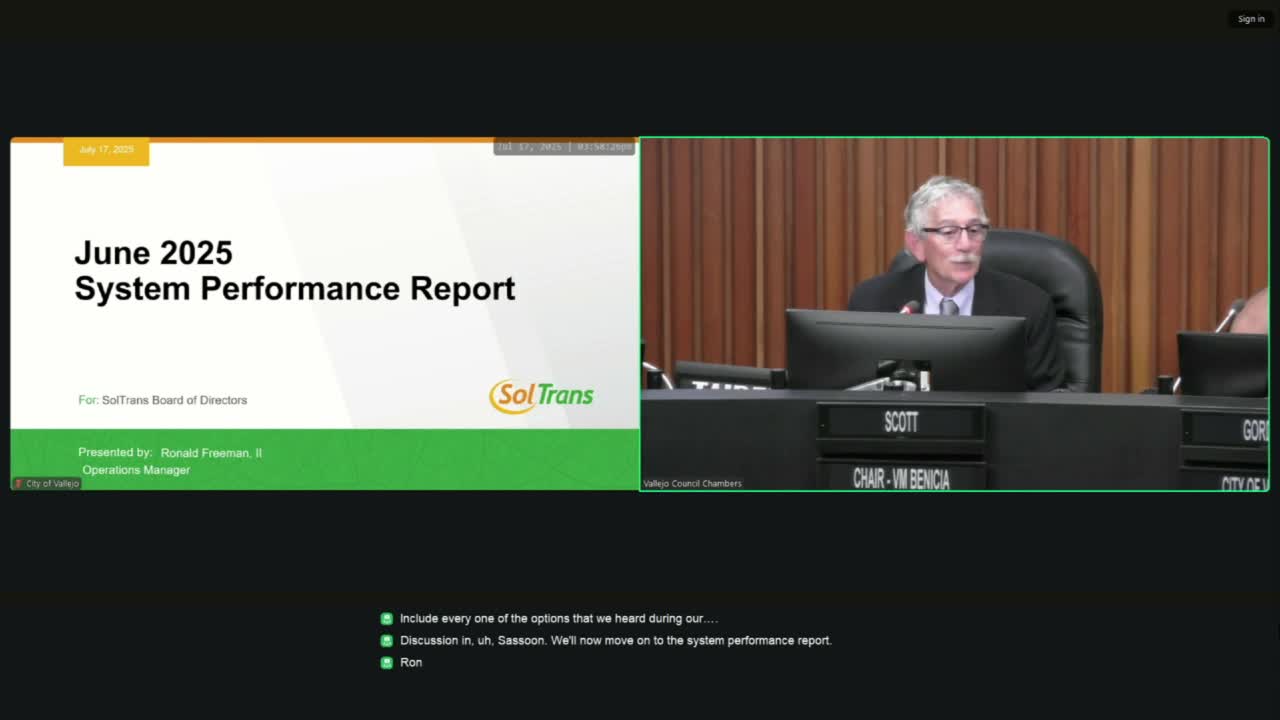
Summary
SolTrans reported rising ridership and reduced missed trips and missed-trip rates, while the board and commenters debated the scope of a Guaranteed Ride Home (GRH) program and how to measure lateness for transit-dependent riders; on-time performance met contract goals.
SolTrans staff reported ridership gains across local, school and express services and a reduction in missed trips, while board members and public commenters debated how a Guaranteed Ride Home (GRH) policy should treat late or missed connections for transit-dependent riders.
Staff told the board monthly and year-to-date ridership is up — local ridership increased, school ridership nearly doubled compared with last summer, and express ridership rose 9 percent. “Ridership year to date is up by 10%,” the system performance presenter said. Staff also said missed trips decreased and both local and express routes have met their contract on-time performance (OTP) goals.
Board members pressed for definitions and metrics. The performance presenter defined missed trips and lateness: “Missed trip is defined as a trip that was not performed or was partially performed, but it was not completed,” and “it’s passengers per revenue hour for productivity for any mode,” when asked to define productivity. Staff said lateness is measured as five minutes or more late for OTP purposes, noting that the five‑minute standard aligns with federal practice.
A wide-ranging discussion followed about how GRH vouchers should be applied. One board member noted that 15‑minute delays in Bay Area freeway corridors are frequent and can be outside agency control, and questioned whether expensive ride vouchers for missed trips were reasonable. Another board member and public commenters emphasized that transit-dependent riders cannot simply plan by catching an earlier bus and that missed connections can cascade into lost work or childcare consequences.
“...when you’re transit dependent, you don’t get to make that plan because you can make that plan or I can make that plan because we got a car,” a board member said, urging the agency to weigh cascading effects when riders miss buses and connections. A public commenter described multiple missed buses creating a day’s worth of disruption for riders who rely on multi-leg trips.
Staff described other performance metrics: verified complaints rose in June (12 complaints, a 67% increase over the prior month), preventable accidents were limited (one preventable and three non-preventable accidents in June), and missed trips as a percentage of scheduled trips declined.
No formal action was taken. Board members said improving frequency and reliability through the COA is a priority so GRH-type programs are used less often. Staff reiterated that increasing driver and schedule adherence and raising frequency are objectives of the COA.
The board asked staff to continue monitoring missed trips and on-time performance and to work with the contractor to limit missed trips and late runs.