
Vallejo design review board recommends approval of 51‑home Vista Cove subdivision to planning commission
Get AI-powered insights, summaries, and transcripts
Subscribe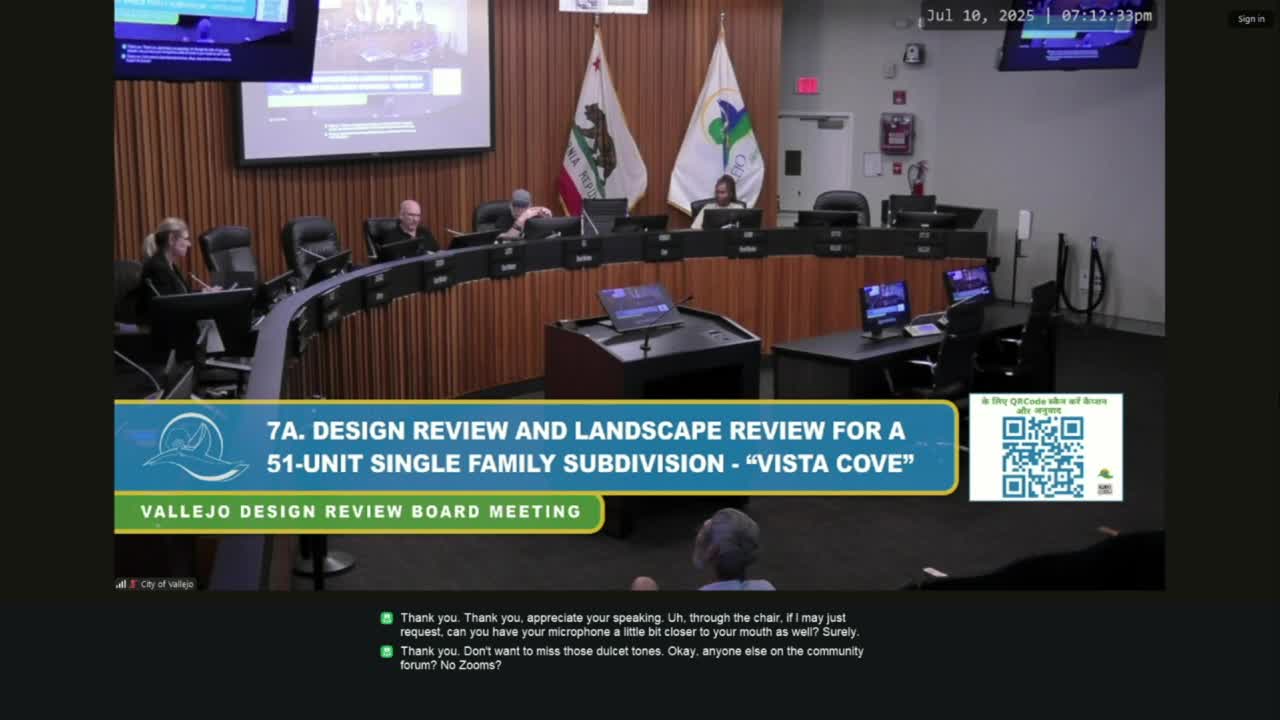
Summary
The Vallejo Design Review Board voted 3-0 to recommend that the Planning Commission consider design and landscape approvals for Vista Cove, a proposed 51‑unit subdivision on a 20.13‑acre site near Shady Lane and Wildflower Avenue.
The Vallejo Design Review Board voted 3-0 on June 26 to recommend that the Planning Commission consider design review (DR23‑0006) and landscape review (LR23‑0002) for Vista Cove, a proposed 51‑unit single‑family subdivision on a vacant 20.13‑acre site near Shady Lane and Wildflower Avenue.
The recommendation followed a staff presentation by Cesar, the city project planner, and public comment from nearby residents who raised concerns about traffic, wildlife movement, tree removal and the project’s visual relationship with Venetia State Park. Adam Smith, the applicant with San Siero Management, answered questions about home sizes, parking and community outreach and said the team is available to meet with affected property owners about buffering and landscaping.
Vista Cove would subdivide the 20.13‑acre site into 57 parcels to accommodate 51 single‑family homes, private roads, alleys and open space, according to Cesar’s presentation. The proposal includes four floor plans with maximum building height listed at 30 feet, 4 inches. The project’s design materials presented floor‑area figures (including garages) that the applicant later clarified as living‑area sizes: 2,050, 2,202, 2,494 and 2,618 square feet, respectively.
The project team said an arborist evaluated 83 trees on the site and recommended removal of 69; 47 of those were classified in the report as “significant” and would be replaced at a 3:1 ratio under the cited Vallejo Municipal Code replacement standard, yielding 141 new trees proposed to be planted on or near the site. Streetscape plans show street trees, shrubs and drought‑tolerant front‑yard landscaping throughout the subdivision.
Several neighbors testified at the hearing. Carol McKenzie, a Glen Cove resident, said, “I’m very concerned about wildlife and the cutting off of portions of wildlife areas where the animals can no longer migrate back and forth because they’ll have to cross the street to do so.” Christine Gibson, a Wildflower Avenue resident immediately adjacent to the property, said she was told earlier home sizes would be “probably between 4,400 square feet” and expressed concern that the project’s final massing and proximity do not fit the existing neighborhood scale. Leigh Nieman, who lives on the corner of Wildflower and Shady Lane, cited watershed and runoff concerns affecting Venetia State Park: “The whole watershed is right there.” Other speakers cited narrow local streets, emergency access and lack of nearby playgrounds.
Board members and staff clarified that the Design Review Board’s role is limited to design and landscape findings and that environmental, traffic, biological and other technical issues will be addressed through the environmental review process. Cesar told the board the project will undergo an environmental review with a draft environmental impact report (EIR) to be posted for public review; the EIR and technical studies are part of the Planning Commission and City Council review, not the board’s discretionary authority.
Parking and driveway depth drew questions. The project provides a standard attached two‑car garage for each home and two additional driveway parking spaces. The applicant said garage depths are 20 feet and that the current design preserves approximately an 18‑foot driveway depth to accommodate standard vehicles; the applicant said very large trucks may not fit in some configurations.
The applicant offered to meet with adjacent property owners to discuss additional landscape materials and buffering; Adam Smith said he would coordinate with staff to connect with residents who submitted written comments. The Design Review Board voted to adopt a resolution recommending Planning Commission consideration of the design and landscape reviews; the board’s clerk announced, “We have 3 ayes and the motion carries.”
The recommendation does not approve the project; it forwards the design and landscape findings to the Planning Commission. Because the project includes a zoning map amendment and planned development, the Planning Commission will make a recommendation to the City Council, which will hold the final decision. The EIR and public comment period are the next formal steps in the land‑use review process.
What happens next: the project will proceed to environmental review with public comment opportunities on the draft EIR, then to the Planning Commission and ultimately to the City Council for final action. Neighbors were advised to monitor the city’s project webpage and upcoming hearing notices if they wish to submit further comments.