
Nearly 50 residents testify on Santee dispensary permits; supporters cite jobs and security, opponents raise youth and public-health concerns
Get AI-powered insights, summaries, and transcripts
Subscribe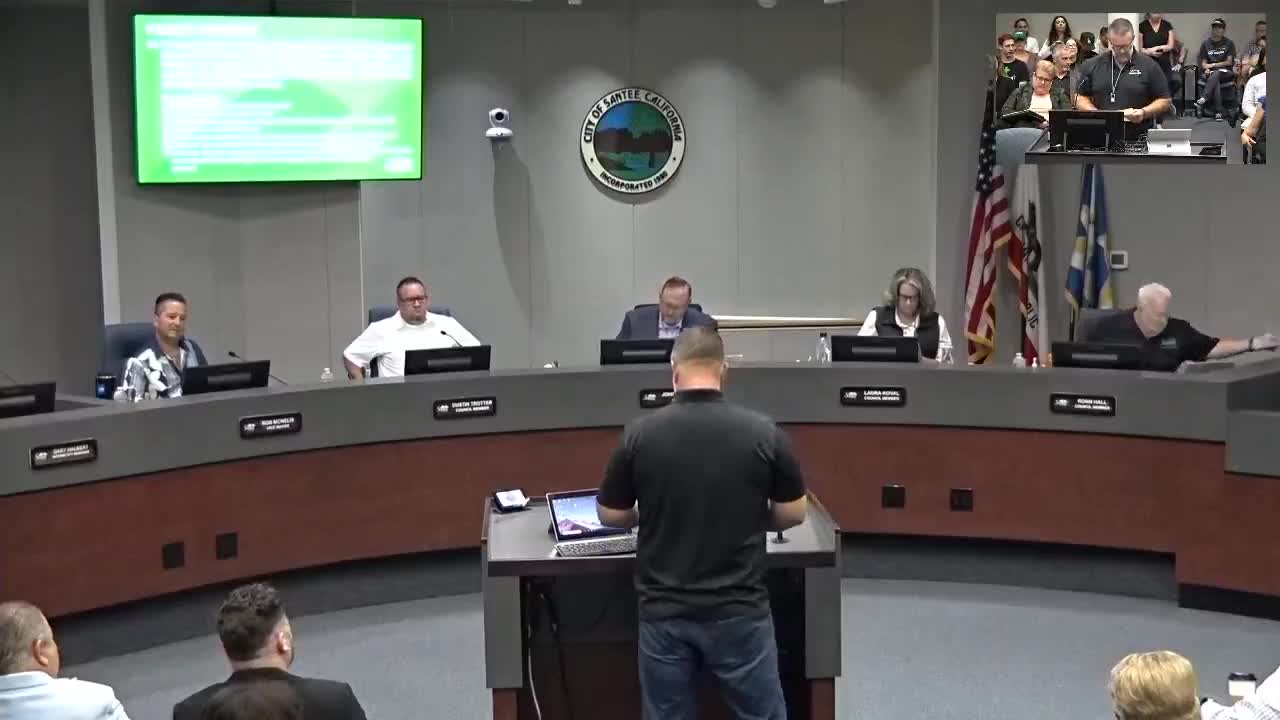
Summary
During a long public comment period dozens of residents, businesspeople and industry employees testified for and against specific cannabis retail applicants, emphasizing local hiring, vendor payment practices and youth-protection programs as deciding factors.
Dozens of Santee residents and industry representatives spoke during a nearly four-hour public comment period as the City Council reviewed competing retail cannabis applications. Supporters argued that carefully run legal stores bring jobs, regulated products and community benefits; opponents warned of health risks for youth and urged the council to pause or reject permitting.
Supporters spoke for a range of applicants. Steven Parkhurst, owner of a newly opened jewelry and loan business on Mission Gorge Road, urged the council to approve Doctor Green Thumbs and said he models some store security protocols on that team’s operations. “They don't look for recognition,” Parkhurst said. “They just care about doing the right thing.”
Employees and vendors also testified. Zach Larson, purchasing manager for Doctor Green Thumbs’ La Mesa store, said his applicant pays vendors on delivery and maintains low debt, calling the applicant an example of “what long term ethical and successful cannabis retail can and should look like.” Multiple brand representatives and vendors backed Off the Charts (OTC), citing on-the-ground operations, vendor communications and employee training programs. Several social-equity partners recounted how larger operators provided financial or operational support during licensing delays in Los Angeles.
Advocates from established local groups — including veterans’ organizations, youth-service leaders and neighborhood associations — said they had met with some applicants and cited community investment plans. John Wooding, a community director who said he has worked with Young Life in Santee, said he joined an applicant’s community advisory board to ensure funds are directed to youth prevention programs.
Opponents urged extreme caution or rejection. Becky Rapp urged the council to consider rejecting all applications, citing data on oversupply and unbuilt permitted businesses in some neighboring jurisdictions. “You are under no obligation,” Rapp told council members, noting the city could legally reject all proposals.
Public-health professionals told the council new retail availability tends to increase youth exposure and hospitalizations. Peggy Walker, who said she works with parent and public-health coalitions, argued the presence of dispensaries “normalizes marijuana, sending the message that it's safe and okay, but it isn't,” and pointed to emergency-room visits and pediatric poisonings.
Several former law-enforcement and public-safety personnel, while sometimes personally opposed to legalization, testified in favor of specific applicants who had engaged them to design security, compliance and community-accountability programs. Mike Aiken, a retired narcotics detective, told the council he had initially opposed permitting but later joined an applicant’s advisory board because “they thoroughly answered my questions about their operations, security protocols, compliance history.”
Applicants’ managers and employees described store-level practices the council later cited when evaluating proposals: multiple ID checks, lobby/controlled-access designs, armed or unarmed security staffing, sealed exit packaging, digital point-of-sale tracking and vendor-relationship protocols. Several applicants told the council they planned to open within months of city and state approvals; estimates provided to the council ranged from a few months up to about a year depending on site work and state processing timelines.
The public comment period and council questioning fed into the council’s deliberations on which operators best matched the city’s ordinance criteria for security, community benefits and geographic distribution. Council members said they were weighing both local ties and operational readiness when they narrowed the applicant list in later votes.