
Planning commission recommends Whittier Council adopt ADU code updates to comply with new state laws
Get AI-powered insights, summaries, and transcripts
Subscribe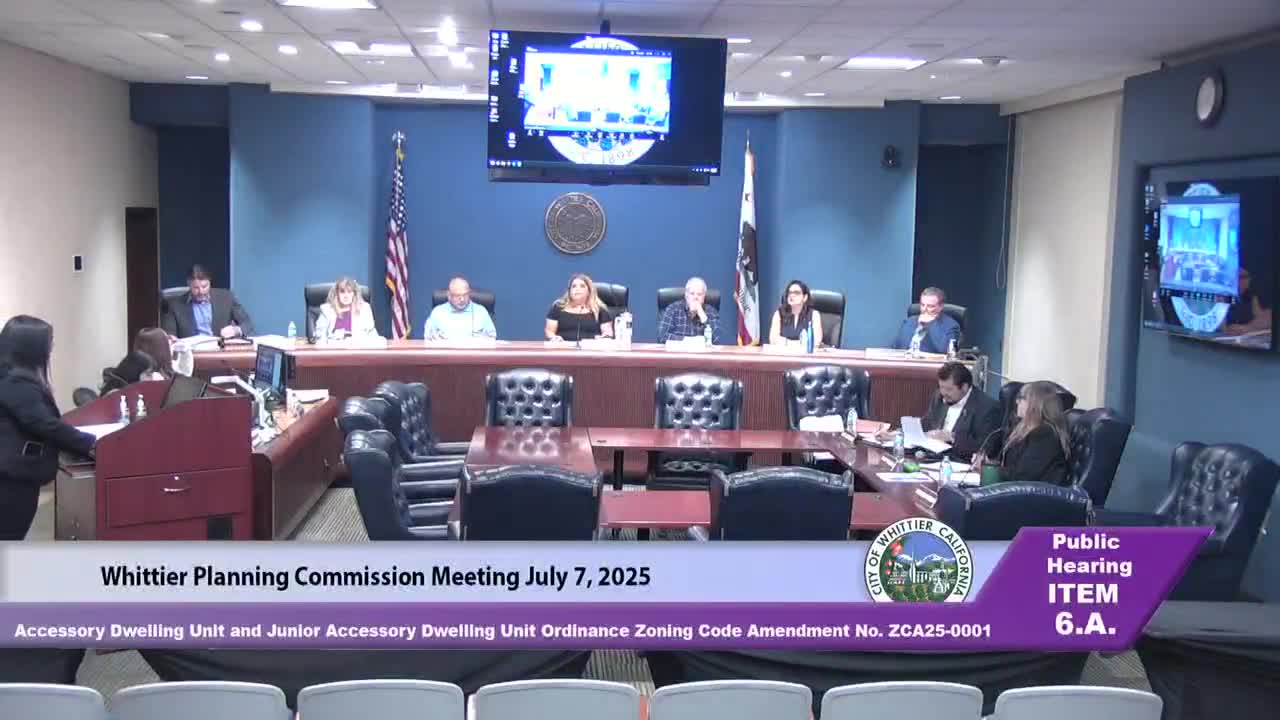
Summary
At its July 7, 2025 meeting, the Whittier Planning Commission voted to recommend that the City Council adopt zoning code amendment ZCA25-0001, a package of revisions to the city’s accessory dwelling unit (ADU) and junior accessory dwelling unit regulations intended to comply with recent state law changes.
At its July 7, 2025 meeting, the Whittier Planning Commission voted to recommend that the City Council adopt zoning code amendment ZCA25-0001, a package of revisions to the city’s accessory dwelling unit (ADU) and junior accessory dwelling unit regulations intended to comply with recent state law changes.
The revisions seek to implement state ADU requirements that took effect this January and include allowing denial of building permits for substandard structures, removing replacement parking requirements for demolished uncovered off‑street spaces, permitting ADUs above a primary dwelling, and increasing ADU allowances on multifamily sites. Monique Garibay, Senior Planner, presented the draft ordinance and the staff recommendation that the commission adopt the attached resolution recommending council approval.
The changes staff highlighted include: “Jurisdictions can have the ability to deny a building permit if a building would be deemed as substandard. Replacement parking will no longer be required for uncovered spaces,” Garibay said. She also summarized multifamily changes: “Existing multifamily residential developments originally were allowed 2 detached ADUs. Now they're allowed up to 8 as long as they don't exceed the number of existing units.” The staff presentation said the ordinance is exempt from the California Environmental Quality Act under Public Resources Code section 21080.17 and that the draft contains both statutory and categorical exemptions because staff expects no significant environmental effect.
Commissioners asked for operational clarifications. Commissioner Quirk asked how multifamily properties would accommodate multiple ADUs and whether they could be stacked vertically; staff replied that conversions of garages or accessory buildings and stacked units are common and that height and story limits remain governed by zone standards. Commissioners also questioned whether construction cost or site conditions (for example, retaining walls on hillsides) would weigh into a prioritization of backyard placement versus front-yard placement; staff said cost is not currently a factor in the ordinance’s placement “waterfall,” which prioritizes rear-yard placement first, then front yard subject to zone setbacks, and allows limited intrusion into setbacks when an 800‑square‑foot ADU cannot otherwise be accommodated.
Garibay and other staff clarified other points commissioners raised: efficiency kitchen is already defined in the code as “a kitchen that includes a cooking facility with appliances and a food preparation counter and storage cabinets that are of reasonable size in relation to the size of a junior accessory dwelling unit”; existing unpermitted units may be legalized through building permit and planning review and must conform to current building code standards; and local code retains a placement preference (rear of lot) while complying with state requirements to allow front‑yard ADUs in constrained cases.
Public comment included one speaker who identified themselves as a Whittier general contractor and asked the commission to consider ways to build two‑story ADUs in backyards—combining over‑garage and adjacent accessory space to avoid front‑yard placement. Staff responded that the proposed ordinance would allow certain second‑story ADUs when attached to the primary dwelling or where consistent with zone height limits, but that single‑story limits for detached ADUs still apply in many single‑family zones.
The commission passed the motion recommending adoption of ZCA25-0001 by roll call; all commissioners voted yes. The action will be forwarded to City Council for final decision.
The commission packet included a clean ordinance and a strikeout/redline showing edits; staff said the packet reorganized existing provisions (moved material shown in blue/green) and flagged new state‑required changes in red to make the changes easier to review.
If the council approves ZCA25-0001 as recommended, the code changes will be applied through ministerial review processes identified in state law; staff noted some issues remain subject to HCD interpretation and could be refined over time.