
Del Mar Fairgrounds launches countywide "Fairgrounds 2050" master-planning outreach
Get AI-powered insights, summaries, and transcripts
Subscribe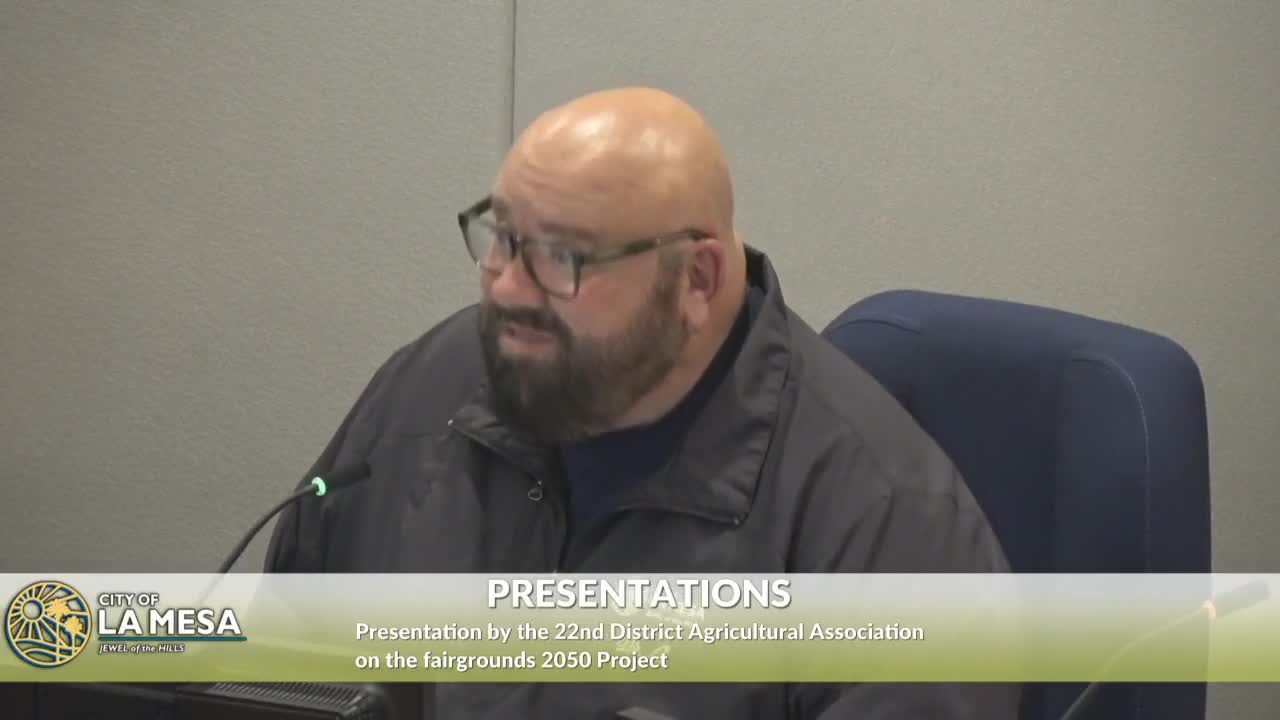
Summary
The 22nd District Agricultural Association outlined a multi-year, community-led master-planning effort called Fairgrounds 2050, saying the district will fund the planning process and pursue an international design competition before starting CEQA review.
The Del Mar Fairgrounds’ governing body, the 22nd District Agricultural Association, presented its Fairgrounds 2050 master site planning program to the La Mesa City Council on July 22, describing a countywide outreach and a multi‑phase timeline that will end with environmental review under the California Environmental Quality Act.
The presentation, delivered by consultant Zach McQuarrie of Southwest Strategies, explained that the district is a state institution governed by a nine‑member board appointed by the governor and that it operates without general taxpayer support. “They don’t receive any taxpayer dollars,” McQuarrie said, adding that revenues from the San Diego County Fair, horse racing and seasonal events fund the district’s operations and, he said, will fund the master‑planning work.
The council heard that the planning effort will evaluate future uses across three Del Mar DAA parcels — the main fairgrounds campus, an RV/Surf & Turf area east of Jimmy Durante Boulevard, and a horse park south of Via de la Valle — a total the presentation described as 324 acres surrounded by environmentally sensitive land. The program will pair broad public outreach with technical review: McQuarrie said the DAA completed a statistically significant countywide survey, has formed a pro bono technical advisory coalition of architects and environmental and land‑use experts, and plans regional workshops in each supervisorial district this fall.
Why it matters: the DAA told the council the fairgrounds generate a substantial regional economic impact and that master planning will guide use decisions affecting coastline and lagoon‑adjacent land. McQuarrie said an international design competition will follow adoption of board guidance, then the district will begin the CEQA environmental assessment before any approvals or construction.
Council members and attendees raised questions about financing and outreach. Council Member Lothian asked, “Where is the money coming from?” McQuarrie reiterated that the district is self‑funded and that the district’s balance sheet — driven by event revenues — will support the planning program. Council Member Casares, who said she had attended an earlier fairgrounds event, encouraged the DAA to include school‑aged participants: “We want y’all to include young people, especially school aged folks, as much as possible since 2050 really is for them,” she said.
The DAA presentation did not propose specific development approvals at this stage. Instead, it laid out the schedule and engagement plan: a green outreach phase already underway; a “purple” design competition phase; and subsequent environmental review. McQuarrie said the district aims for the process to be community led rather than developer driven.
No formal council action was taken at the meeting; the item was a presentation and opportunity for questions. The DAA and consultant provided contact information and encouraged residents to participate in upcoming workshops and surveys.
The council meeting file includes materials the DAA said it will circulate to jurisdictions and stakeholders as the outreach schedule is finalized.