
9‑1‑1 enterprise board adopts 2026 budget draft, authorizes final memo and 3¢ fee submission to PUC
Get AI-powered insights, summaries, and transcripts
Subscribe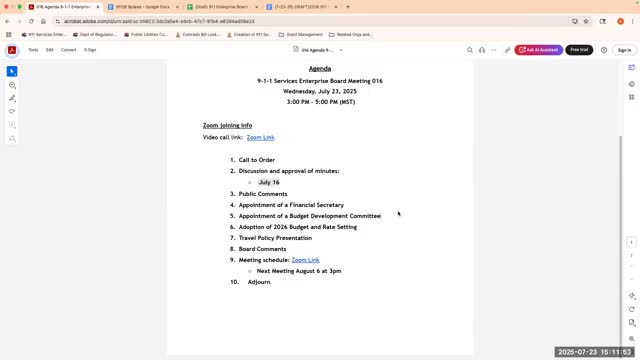
Summary
The 9‑1‑1 Services Enterprise Board voted to adopt a draft 2026 budget with the adjustments discussed at its July 23 meeting and authorized staff to finalize and file a budget memo with the Colorado Public Utilities Commission.
The 9‑1‑1 Services Enterprise Board voted to adopt a draft 2026 budget with the adjustments discussed at its July 23 meeting and authorized staff to finalize and file a budget memo with the Colorado Public Utilities Commission. The motion, moved by Matt and seconded by Amy, passed on a voice vote with three ayes and one abstention.
Board members said the action matters because the enterprise must set a budget and a fee that the PUC will incorporate into the statewide 9‑1‑1 surcharge calculation; the board’s draft recommends a 3¢ enterprise fee assessed per 9‑1‑1 access connection per month.
Board member Lynn, newly appointed financial secretary and chair of the budget development committee, presented a cleaned draft budget and asked the board to confirm several technical choices: whether to present first-year revenue as 9 months or 12 months (collections will not begin until about March), how to treat per‑penny revenue assumptions, and whether to preserve a program reserve. Lynn said, “my read of [the legislation] is that we are to set the budget and set the fee,” and proposed the draft reflect realistic collections for the enterprise’s first partial year of receipts.
PUC staff clarified the statewide per‑penny amount used for estimates. Daryl, speaking for PUC staff, said the magnitude varies with the number of statewide access connections and that “currently, we are about $830,000 per year per penny of surcharge,” but that using $800,000 is a reasonable planning assumption.
After discussion the board agreed to present the 2026 budget based on a partial‑year (roughly nine‑month) revenue projection rather than a full 12 months. Board members asked that Lynn remove month‑count headers from the public spreadsheet and report specific dollar amounts in the final memo. The board also confirmed a $200,000 allocation for the Colorado 9‑1‑1 Resource Center in the draft and discussed setting the program reserve at roughly 7% of program expenditures for the first year.
Cybersecurity was raised as a possible program priority. Matt observed that cybersecurity could be funded from the board’s local‑authority grant category and said the board should not exclude cybersecurity from grant eligibility: “we could still address cybersecurity, especially if someone asked for it,” he said.
Timing and filing steps were clarified. PUC staff advised that the commission’s proceeding would open in early August and that public comments would likely be due in late August; Jennifer (PUC staff) said comments would be due by Aug. 22 if the commission opens the proceeding at its weekly meeting on Aug. 1. The board scheduled a next meeting for Aug. 6 and authorized Michael to finalize the memo and submit it once Lynn and Matt provide final edits.
Motion and vote: Matt moved that the board “adopt the budget with the adjustments made in discussion today and authorize Michael to finalize the budget memo with the adjustments per discussion today and then submit it.” Amy seconded. The chair called for the vote; the board recorded three ayes and one abstention. The motion passed.
What happens next: Lynn and Matt will send final edits to board staff (Sage) and Michael will file the board’s memo into the PUC proceeding. PUC staff offered to accept the filing on the board’s behalf. The board will revisit the budget and any form edits at its next meeting if needed.
Sources: Board discussion July 23, 2025; PUC staff comments on per‑penny revenue and filing schedule.