Get Full Government Meeting Transcripts, Videos, & Alerts Forever!
Get email alerts on the Water Treatment And Cip topic
No spam. Unsubscribe anytime.
Delray Beach to seek revenue bonds for $270M water treatment plant; CIP includes police HQ, Pompey Park and stormwater work
Summary
City staff presented a capital improvement program that centers on a $270 million water treatment plant to address PFAS, a planned $140 million initial revenue bond, a roughly $100 million police headquarters from a public-safety GO bond, and multiple neighborhood and resiliency projects.
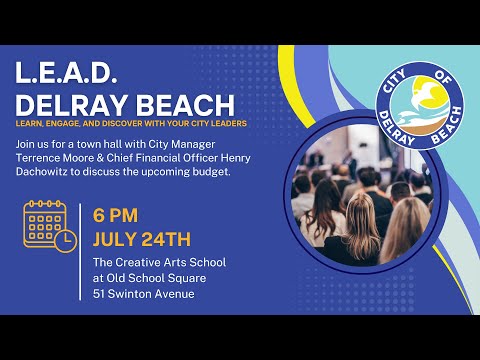
City staff detailed an ambitious capital improvement program at a July 24 town hall that centers on replacing Delray Beach—s aging water treatment facility, addressing PFAS concerns and funding several large infrastructure projects.
Director of Public Works Missy Barletto and Chief Financial Officer Henry Dacouis said the city expects the new water treatment plant to cost about $270 million in total. Staff said they plan an initial revenue-bond transaction of about $140 million in the first year and a later tranche of roughly $130 million; construction will begin this winter and staff expect the plant to be "complete in early 2028." Barletto described the new plant as replacing a 63-year-old facility and moving from a lime-softening process to a nanofiltration approach.
Why it matters: Staff framed the project as the long-term solution to PFAS detections in parts of Delray Beach—s water system and as a major capital investment requiring multi-year financing and construction. The funding strategy combines revenue bonds, enterprise-fund resources and other capital funds rather than relying on the general fund.
Key CIP and financing details presented: - Water treatment plant: total estimated cost ~$270,000,000; first revenue-bond tranche ~$140,000,000; remaining ~$130,000,000 in later years; construction slated to start this winter; expected operational in 2028 (Missy Barletto and Henry Dacouis). - Financing approach: staff emphasized revenue bonds for utility projects, general-obligation (G.O.) bonds for voter-approved public-safety projects, and revenue bonds or enterprise-backed debt for recreation and user-fee facilities. - Public-safety G.O. bond: the presentation said a public-safety/general-obligation bond (voter referendum required) will fund a new police headquarters, estimated near $100,000,000, and other station improvements; design work begins this year. - Recreation revenue bonds: staff noted roughly $20,000,000 allocated for recreation projects, including a planned renovation of the municipal golf course financed by user-fee-backed revenue bonds; the course will close about one year for renovation. - Major CIP projects: Pompey Park recreation facility (construction starting), Northwest neighborhood infrastructure overhaul (water, sewer, streets, traffic-calming), Tropic Isle stormwater project (~$50,000,000 total) with state resiliency grant support covering about half, Marine Way seawall and roadway redesign, new stormwater pump station west of the Intracoastal, roadway projects (North Swinton roundabout, Lindell Boulevard, Barwick Road/Atlantic Avenue corridor). - Grants and partners: staff referenced state resiliency grant funding (roughly $20,000,000 toward Tropic Isle) and planned Army Corps of Engineers beach renourishment work beginning this fiscal year.
On next steps, staff said the revenue-bond transaction for the water plant will be initiated at the Aug. 12 regular city commission meeting; Dacouis said the city is "teed up" to borrow in the next one to two months. He described bond issuance as a way to match long-lived assets with long-term financing so future beneficiaries share cost.
The presentation also noted shorter-term milestones: Fire Station 113 is essentially complete, with a public opening ceremony scheduled for 10 a.m. the following day; Pompey Park construction will proceed while an existing community center remains open; and several roadway projects have aggressive construction timelines tied to school start dates in August.
No formal bond approval occurred at the town hall; staff presented project costs, funding plans and the schedule for required commission actions.