Get Full Government Meeting Transcripts, Videos, & Alerts Forever!
Get email alerts on the Crisis Response topic
No spam. Unsubscribe anytime.
Committee approves $1.13 million contract to continue Elm City Compass crisis team
Summary
The New Haven Board of Alders’ Health and Human Services Committee voted July 24 to authorize a contract with Continuum of Care to operate the Elm City Compass crisis response team for fiscal year 2026, continuing current hours and service levels while the city plans for long-term sustainability.
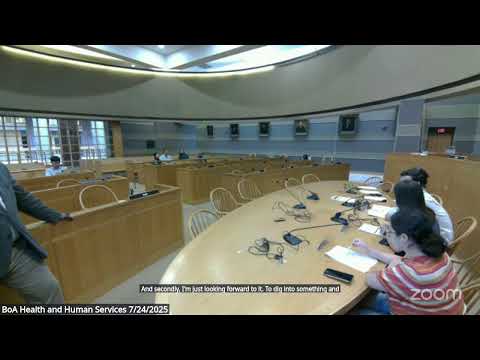
The New Haven Board of Alders’ Health and Human Services Committee voted July 24 to authorize an agreement with Continuum of Care not to exceed $1,128,416.12 for the Elm City Compass crisis response team for the period July 1, 2025, through June 30, 2026. Eli Stavenhart, chair of the committee, called the meeting and the committee approved the item by voice vote; the transcript records members saying “aye” and the item passed, with a recorded tally not specified in the meeting record.
The contract continues the program’s existing response hours and staffing model while the city transitions management away from Yale University and toward direct contracting with Continuum of Care. “We are here tonight to present, proposal to enter into a contract with continuum of care to continue the Elm City Compass team operations,” presenter Lorena Mitchell said. Mitchell described the fiscal-year contract as a transitional year intended to allow the city to “take a step back, evaluate, understand where we’ve been and how we can move forward.”
Why it matters: Elm City Compass provides non-police crisis response for people experiencing mental-health, substance-use, and housing crises. Committee members and presenters said the program reduces demand on police and fire resources and is part of the city’s longer-term plan to make the service sustainable without it remaining a pilot.
Program details and performance: Mitchell told the committee that, as of June, Elm City Compass had conducted more than 2,700 crisis responses citywide; the team’s average response time was 14 minutes and teams spent about 40 minutes on scene. She said a little more than half of responses came via PSAP at the request of police or fire, while about 43% were responses to community partners or direct-dispatch situations. Mitchell also said the program’s evaluation estimated the team saved “a little over 25 weeks of police time and a little over 4 weeks of fire time” in its first two-and-a-half years.
Scope of the contract and operations: The presenters said the FY26 contract covers operation of the crisis response team only; other Compass components (service coordination, community advisory board, evaluation) are covered by a no-cost extension with the university. Mitchell described current team coverage as “a continuation of current service that is, from 8AM to 3AM, 7 days a week with 3 different shifts,” with each dispatched pair typically including a clinician and a peer. Continuum of Care was designated the sole-source vendor for the contract, the presenters said, and the FY26 agreement represents a transition from Yale’s previous subcontract model.
Oversight, finances and next steps: Committee members asked how direct contracting would change fiscal oversight and administrative responsibilities. Teosia Kemp, director for the Department of Community Resilience, and Mitchell said the city will have closer invoicing and oversight with a direct contract than under the prior Yale subcontract arrangement, and that a short bridge contract was in place from July 1 through Aug. 15 to avoid service interruption. Mitchell and Kemp said the city plans additional planning and a fuller workshop on Elm City Compass in the fall to discuss sustainability, data-sharing, and institutional buy-in from partners such as Yale New Haven Hospital. Presenters said the city is exploring additional funding and institutional support but did not state a finalized funding mix.
Discussion and concerns: Committee members asked about operational continuity after leadership changes and about data-sharing and duplication of services. Presenters acknowledged the importance of retaining institutional knowledge from staff who led the pilot phase and said those staff would be involved in planning during the transition year. Presenters also described ongoing work to refine dispatch protocols, community training on when to request Compass instead of police, and coordination with outreach providers.
Decision and implementation notes: The committee approved the order to authorize the contract; the meeting transcript records a voice vote with members saying “aye” and the item passing. The transcript does not record a formal roll-call tally in the public record excerpt. Presenters requested a rapid finalization of the contract to avoid a gap in services and said they will return to the committee with a more detailed workshop and planning materials in the fall.
Sources: Meeting presenters and committee members at the Board of Alders Health and Human Services Committee meeting, July 24, 2025.