Get Full Government Meeting Transcripts, Videos, & Alerts Forever!
Get email alerts on the Sunshine Law Training topic
No spam. Unsubscribe anytime.
City lawyer briefs Citizens Police Review Board on Missouri sunshine law and meeting rules
Summary
Earl Krause of the City Law Department reviewed Missouri’s sunshine law, city code provisions for closed meetings and records, notice and minutes requirements, email and public-records risks, and penalties for violations.
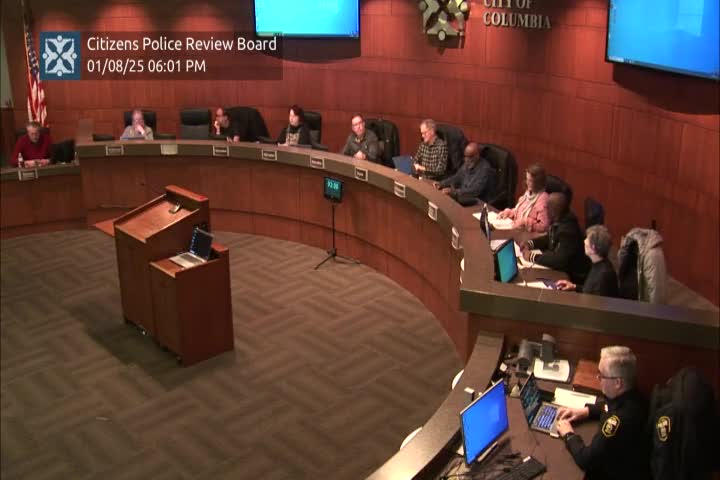
Earl Krause, an attorney in the City Law Department, gave a training on Missouri’s sunshine law at a Columbia Citizens Police Review Board meeting, stressing that meetings and records are presumed open unless a statutory exemption applies.
Krause said the sunshine law “promotes open government,” and walked board members through the law’s requirements for notices, minutes, closed sessions and public records, noting overlapping city-code provisions. He told the board that the state sunshine statute (chapter 610 of the Revised Statutes of Missouri, as referenced in the presentation) authorizes, but does not itself always require, particular closings; the city code contains implementing language for closed meetings (cited in the presentation as sections 2-25.1 and 2-25.3).
Krause reviewed core duties: post meeting notices at least 24 hours in advance (including date, time, place and method of the meeting), keep minutes that record the date, time, place, members present or absent and all votes taken, and include a tentative agenda that reasonably informs the public about matters to be considered. He emphasized that a meeting can occur in many forms whenever a quorum discusses public business, including by phone or electronic means, and cautioned that social-media exchanges that involve a quorum may inadvertently become meetings.
On closed sessions, Krause said meetings are presumed open and may be closed only under specific statutory exemptions. He ran through exemptions he identified in the statute and in the city code (litigation, personnel discipline, sealed bids, property purchases, and other listed categories), and said a board must announce the statutory basis for closing in its posted agenda and obtain a roll-call vote recording each member’s vote to enter closed session. He warned that members must limit discussion in closed session to the reasons cited on the agenda and that adding new topics while in closed session is not permitted.
Krause also discussed public records. He told members that records include retained emails, texts, voicemails, presentations and recorded statements, and that sharing city-business emails with a majority of a body creates a record the city must maintain and could become subject to a public-records request. He recommended routing communications through the staff liaison (Rose) or having staff circulate materials as blind copies to minimize accidental serial discussions among a quorum.
Krause reviewed penalties: the statute provides fines for knowing and purposeful violations (he cited a $1,000-per-violation figure for knowing violations and up to $5,000 per violation for purposeful violations as explained in the presentation) and noted that a judge may void actions taken in violation of the law, which could expose the city to further litigation. He left printed copies of an Attorney General’s office booklet on the sunshine law and offered to provide his slides and contact information to board members.
Board members asked clarifying questions about sub-quorum gatherings, whether calling a meeting when a quorum is unlikely creates risks, handling absences that break quorum, and how email practices affect records. Krause and staff recommended caution: avoid piecing together decisions across multiple sub-quorum meetings, avoid substantive discussion when a previously called meeting lacks a quorum, and route group communications through staff to preserve records and avoid inadvertent meetings.
The presentation closed with staff agreeing to circulate the slides to members and leave printed materials for distribution.
Ending: The training concluded with board members thanking Krause; staff agreed to email the slides and to provide additional copies of the Attorney General’s booklet.