
County hears three broker proposals as health plan shows loss ratio above 100%
Get AI-powered insights, summaries, and transcripts
Subscribe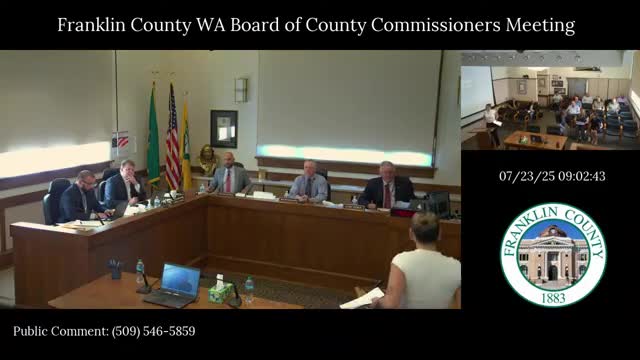
Summary
Three firms — HUB International, Marsh McLennan Agency and Alliant Insurance — gave finalist presentations to the Franklin County Board of Commissioners on July 23 as the county prepares for an August renewal of its employee health plan.
Three firms — HUB International, Marsh McLennan Agency (MMA) and Alliant Insurance — gave finalist presentations to the Franklin County Board of Commissioners on July 23 as the county prepares for an August renewal of its employee health plan. The presentations included population analyses, proposals for member engagement and modeling tools; presenters warned that current claims experience points to a rate increase if carriers hold their filed trends.
The presentations matter because the county’s current fully insured plan is running well above break‑even this plan year, several presenters said, and that will shape renewal offers and the county’s near‑term options, including discussions about VEBA contributions and longer‑term alternatives such as level‑funded or self‑funded arrangements.
HUB International lead consultant Brandon Cleary told commissioners that the county’s prior plan year had a loss ratio of about 77.5% (about $2.1 million in paid claims on roughly $2.7 million in premiums) but that the most recent six‑month snapshot showed roughly $1.6 million paid claims against about $1.4 million in premiums — a loss ratio near 110%. Cleary said that “where we sit today, we’re looking at a trend renewal for Premera … probably going to be in the range of 12 to 13% out of the gate,” and emphasized the firm’s experience and tools, including a persona analysis that segments employees by age, service years and plan enrollment.
Alliant consultants highlighted modeling and underwriting capabilities they said would help the county evaluate contribution changes and funding alternatives. Alliant emphasized analytics and underwriting depth for groups considering refunding or self‑funding and noted existing pooled stop‑loss/refunding arrangements for public‑sector clients. “We are the largest independently owned brokerage firm in The United States,” said Alliant presenter Sean Sicilio while describing the firm’s market clout and underwriting resources.
Marsh McLennan framed its approach around long‑term sustainability and employee education, stressing pharmacy cost risk and the importance of population‑health initiatives and member advocacy to reduce avoidable spend. Marsh’s presentation focused on building a multi‑year plan and on employee communications, claiming close experience managing large municipal groups and local provider relationships that can expedite claim resolution.
Commissioners asked whether large active claims would push renewals higher; presenters said there were multiple large claims this year and at least three pooled claims that will affect risk calculations. HUB and Alliant said they could provide detailed monthly experience reports, plan modelers that show contribution and design changes in real time, and standalone analytics. HUB noted a prior premium holiday and a seven‑year average renewal of about 5.74% on accounts it described as successfully negotiated, but both HUB and Alliant cautioned that the current rolling 12‑month loss ratio and the active large claims point toward a higher baseline trend.
After the presentations and a short recess, commissioners discussed next steps and agreed to delay a broker selection. Commissioner [unnamed] said he was prepared to decide that day but the board ultimately agreed to reconvene next week to select a broker and direct the chosen firm to begin negotiations and renewals work. Commissioners also asked staff to keep the benefits committee and bargaining teams involved and to request detailed renewal proposals in August.
What’s next: the county will continue benefits committee meetings, gather renewal quotes starting in August, and the board expects the finalists’ analytic models and contribution/migration tools to be made available to bargaining units and committee members before any adoption of substantive contribution or design changes.