
St. Louis CDA details priorities and timeline for 2026 CDBG funding, highlights tornado recovery and NRSA requests
Get AI-powered insights, summaries, and transcripts
Subscribe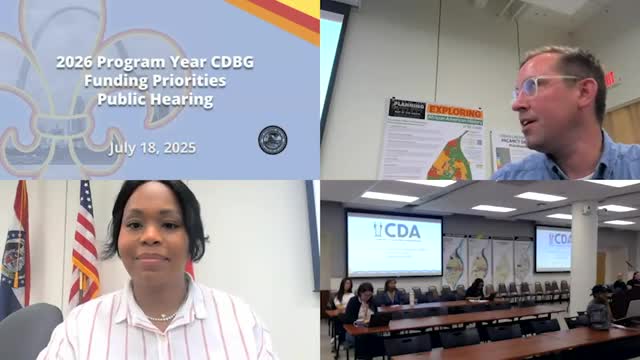
Summary
Rishanda Alexander, director of compliance for the City of St. Louis Community Development Administration, opened a public hearing July 18 to announce funding priorities and the application timeline for the 2026 Community Development Block Grant (CDBG) entitlement program administered by HUD.
Rishanda Alexander, director of compliance for the City of St. Louis Community Development Administration, opened a public hearing July 18 to announce funding priorities and the application timeline for the 2026 Community Development Block Grant (CDBG) entitlement program administered by HUD.
The hearing matters because CDBG funds are a major federal source for housing, public services and public improvements aimed at low- and moderate-income residents; Alexander said the administration is prioritizing affordable housing, economic development, youth services and tornado recovery in the 2026 action plan.
CDA, which Alexander described as “the clearinghouse of a variety of federal funds,” said the consolidated planning process completed last year shaped this cycle’s priorities. The agency posted a timeline July 3 and will publish the RFP (request for proposals) on Aug. 1, followed by a best-practices webinar on Aug. 15. Applications will be due Sept. 5 at 4 p.m. through the city’s new Salesforce grants portal, staff said. Tom Makel, public information officer for CDA, said materials, slide decks and a recording of the hearing will be posted on the CDA page of the city website.
Alexander explained CDBG grants must meet one of three HUD purposes: benefit low- and moderate-income persons, eliminate slum and blight, or meet urgent needs. She said eligible activities include public services, economic development, public facilities and construction, and acquisition. On eligibility questions during the hearing, Alexander said free legal services for small businesses and nonprofits can be CDBG-eligible and that applicants may submit proposals for more than one project.
A notable change CDA described is its use of Neighborhood Revitalization Strategy Areas (NRSAs). Alexander said CDA has proposed additional NRSAs to HUD and that an NRSA designation allows a jurisdiction to exceed HUD’s 19% cap on public-services spending in designated areas. The administration said it had submitted revised NRSA boundaries that include the Martin Luther King Boulevard corridor, North NRSA, Penrose, O’Fallon, College Hill and Southeast NRSA; one existing NRSA already has HUD approval. Alexander characterized the additional NRSA designations as pending HUD approval.
Tornado recovery emerged as a newly elevated priority for the 2026 action plan. Alexander said tornado-related needs were added via a substantial amendment to the consolidated plan and that eligible tornado-recovery activities could include temporary shelter, home repairs, mental-health services, legal services and coordinated case management for affected residents and businesses. She advised applicants to describe how proposals fit HUD’s statutory purposes; how a particular tornado-response activity would be categorized (for example, urgent need or LMI benefit) will depend on that application’s details.
Staff did not provide total program dollar amounts at the hearing. Alexander said funding totals “have yet to be stated” publicly and will be shown in the RFP. CDA staff repeatedly encouraged interested applicants to review the agency’s 2020–2024 impact report and past award announcements on the CDA website to see examples of previously funded organizations and projects.
Questions from the in-person and virtual audience covered administrative details: whether the RFP will list grantee reporting requirements (Alexander said RFPs generally do not list reporting requirements), whether CDA will provide step-by-step application videos for first-time applicants (staff said no such step-by-step video exists but that best-practices trainings and past materials are available), and whether CDBG funds may be used for both acquisition and construction of buildings (Alexander confirmed both are eligible activities). Staff also reiterated that the agency is transitioning to a Salesforce-based grants management system and will post guidance and the RFP link on the CDA website.
No formal votes or funding allocations were taken at the hearing. CDA staff closed the session by restating the RFP release date, the Aug. 15 webinar, and the Sept. 5, 4 p.m. application deadline.