Get Full Government Meeting Transcripts, Videos, & Alerts Forever!
Get email alerts on the Immigration Services topic
No spam. Unsubscribe anytime.
Seattle OIRA outlines legal, language and workforce supports for immigrants and refugees
Summary
The Office of Immigrant and Refugee Affairs told the Library's Education and Neighborhoods Committee on July 24 that it is expanding rapid-response legal outreach, citizenship assistance, language access and job-readiness programs to reduce fear in immigrant communities amid shifting federal immigration policy.
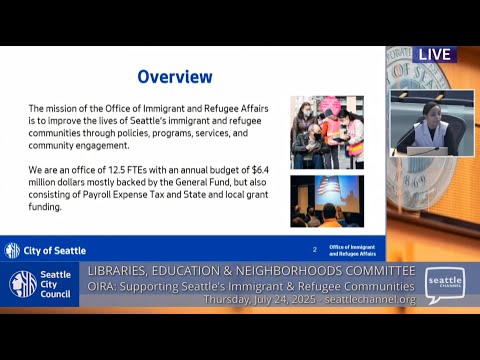
Hamdi Mohammed, director of the city—s Office of Immigrant and Refugee Affairs, told the Library's Education and Neighborhoods Committee on July 24 that OIRA is expanding programs to help immigrant and refugee residents access legal services, language assistance and job training. The briefing centered on OIRA—s rapid-response, legal-defense, citizenship, language-access and Ready-to-Work efforts and included program metrics, funding sources and requests for pro bono legal support and additional partnerships. The update matters because federal policy change and media coverage, OIRA said, have produced a chilling effect that can keep people from getting food, health care, schooling and other city services; the office described itself as a local source of accurate, timely information and coordination. Mohammed told the committee, “We are here to show how we are listening as a city, how we—re acting and protecting access to opportunities.” She said OIRA has about 12 staff and a budget of roughly $6,400,000, primarily from the general fund with some state grants and payroll-expense-tax revenue, and that the office is pursuing additional state and philanthropic funding. On enforcement and rapid response, Mohammed said statewide calls to the deportation-defense hotline tracked by partners numbered 739; 109 calls were from Seattle and eight were verified as ICE activity inside the city limits. She added, "the short answer to that is no" when asked whether large-scale ICE raids like those reported in other cities were taking place across Seattle. OIRA gave the committee multiple program metrics it said demonstrate reach and outcomes: its rapid-response grantee network ran seven know-your-rights events in the first quarter that reached about 170 participants and provided roughly 191 hours of legal consultation that assisted about 83 individuals. Two larger information sessions reached about 475 people. OIRA—s legal-defense contractors provided, in one recent reporting period, about 215 people full legal representation per quarter and delivered limited services to roughly 295 additional people; partners helped about 82 people obtain work authorization and helped 52 people secure an immigration status. Staff said partners filed about 148 relief requests and attended about 38 immigration-court hearings. On detention and court trends, OIRA relayed data from the Northwest Immigrants— Rights Project (NERP) showing about 25 people per month from King County were being transferred to the Tacoma Detention Center; many arrests, the office said, occur after immigration-court hearings rather than in-home raids. Mohammed said NERP data showed 45 people were detained after attending hearings at the Seattle immigration court, 24 of whom went to detention; only two of those 45 opted to appeal, she said. OIRA described other programs it runs or funds: a citizenship program that it said supported more than 1,000 community members in 2024 and helped nearly 700 applications reach filing with professional support; more than 7,000 hours of English and civics instruction and roughly 560 mock interviews. Since the program—s launch, OIRA said it has assisted roughly 32,000 residents and helped submit about 16,000 citizenship applications; the office estimated the resulting increases in income from naturalization translate to millions flowing back into the local economy. The Ready-to-Work program, OIRA said, served more than 1,000 adult learners and recently launched a childcare-focused cohort to train workers for in-demand childcare jobs; the office reported quarterly cohorts of roughly 200 participants with about 41 percent either actively seeking work or finding jobs. Language-access work, the director said, is grounded in federal requirements under Title VI of the Civil Rights Act and involves about 50 independent community translators; city staff received more than 270 trainings in 2024 and the office supports centralized translation systems used across departments. Mohammed described WAMAS (the state Migrant and Asylum Seeker Support program) operations that the city is supporting: since July 1 the program has used state funds to house about 302 people (more than 100 families), she said, noting many participants later obtain work authorization and transition off emergency assistance. Committee members asked about interpreter availability for community events, the vulnerability of nonprofit partners to federal funding cuts, staff training continuity and whether landlords should be educated about requests for tenant information. Mohammed and her staff said OIRA can help connect council offices and departments to translators, is working with partners to identify alternative revenue sources and regional coordination, and is pursuing citywide training pathways so that knowledge persists through staff turnover. Chair Maritza Rivera thanked the director and staff for the briefing and said the committee and city will continue to rely on OIRA data and outreach to reduce fear and keep residents accessing services. OIRA did not ask the committee to take immediate legislative action; the office asked council members to amplify requests for pro bono attorneys and community legal services and to refer constituents to the hotline and partner organizations named during the presentation. The office said it will continue regular reporting and return with further data on partner capacity and program demand. For more information, OIRA listed referral and partner organizations during the presentation and encouraged attorneys to volunteer with local pro bono efforts.