Commission votes to hold public hearing on 108 Water Street mixed-use waterfront project
Loading...
Summary
Developers presented a 4.5-story, 2.7-acre mixed-use proposal at 108 Water Street that would add offices, 59 residential units, a restaurant, 14 boat slips and more than an acre of public realm; the Planning & Zoning Commission agreed to schedule a public hearing and asked for further review of traffic, drainage and design details.
A preliminary presentation for a proposed 4.5-story mixed-use development at 108 Water Street drew extensive questions from the Norwalk Planning and Zoning Commission on traffic, stormwater and design, and the commission voted to hold a public hearing on the project.
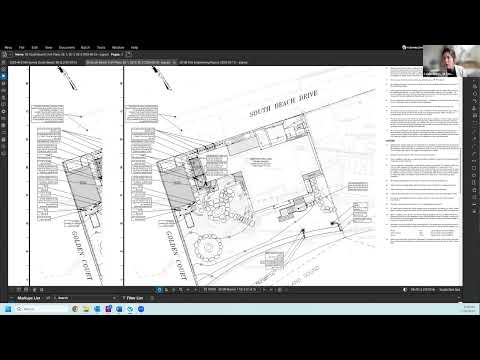
The applicant, represented by attorney Adam Blank, said the joint venture between Spinnaker and the Gersten family would redevelop a largely paved 2.72-acre site with boardwalk, boat slips, public park space, about 110,000 square feet of gross office space and 59 apartments. ‘‘We are proposing about 37% of the site to be public realm,’’ Blank said during the presentation, and estimated initial permit and development fees of about $1.25 million and a future annual property-tax contribution in the order of $500,000 when fully occupied.
Commissioners and staff pressed the project team on operational and resilience questions. Project engineer Vince Hines and consultant Brian Dempsey (traffic) described drainage improvements, including underground infiltration systems and green roofs designed to treat roughly 70–79% of the site runoff, and a hydrologic strategy aligned with the city’s resilience guidance. Commissioners asked whether key lobbies and entrances should be designed higher now in case Water Street is raised later; the design team said primary living areas are above flood elevation while some ground-level lobbies were sized so they could be raised in the future if the city elevates the roadway.
Traffic engineers said the design provides 249 parking spaces with a shared-parking analysis indicating supply would exceed need at peak hours; Transportation, Mobility and Parking (TMP) is reviewing driveway geometry and ingress/egress alternatives (right-turn-only options were studied). Commissioner concerns about morning-peak merging and pedestrian crosswalks led the commission to request further TMP coordination.
Architect Ceylan Path described a plan of two street-facing ‘‘factory’’-style buildings, a central public court and a waterfront boardwalk, and said the team is seeking a mix of office sizes — including large units — and family-sized apartments (including 3- and 4-bedroom units and affordable 3-bedroom units). Blank said the team expects to return in September and noted the project must secure state permits for the proposed boat slips.
The commission voted to hold a public hearing, with members saying the scale merits full public review and additional study of traffic, drainage and architectural details. Staff and the applicant will set a hearing date in consultation with TMP and other reviewing agencies.
Why it matters: The proposal would place a significant amount of new office space and housing on a central waterfront parcel, create public access to the harbor, and require coordination with multiple state and city agencies on docks, flood resilience and traffic.