
Zionsville Plan Commission debates new rules, sign‑in sheets and a consent agenda for routine plans
Get AI-powered insights, summaries, and transcripts
Subscribe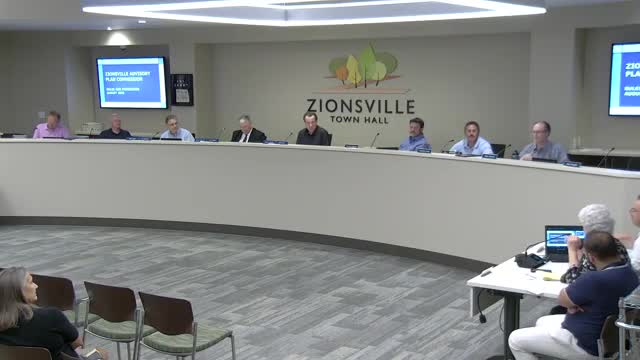
Summary
Planning staff reviewed updated rules and procedures, sparking a broad discussion about ex parte contacts, public‑hearing format, sign‑in sheets, what constitutes a complete application, continuances and a proposed consent agenda for routine development plans.
ZIONSVILLE, Ind. — At its May 19 meeting the Zionsville Plan Commission discussed a set of updated rules and procedures staff proposed to clarify public‑hearing procedures, application completeness, ex parte guidance and a possible consent agenda for routine development plans.
Planning staff outlined rule changes intended to reflect recent statutory changes and to standardize how cases are filed, reviewed and noticed. Staff said notable updates include allowing limited off‑record discussion between commissioners, petitioners and council members on pending items (with guidance to avoid prejudicial contacts), extending public‑notice timing to 14 days, and clarifying the geographic notification radius (two properties or 660 feet, whichever is less). The rules also propose a sign‑in sheet for public hearings, stricter documentation of what constitutes a complete application, and a process to handle new material introduced after a staff packet is published.
Commissioners debated several operational points. Some members said they value the commission’s more open, less time‑restricted public‑comment tradition and opposed a strict three‑minute cap; others urged codified time limits and a sign‑in sheet so the record shows who spoke — a change several commissioners said helps determine who may later appeal under state statute. One commissioner suggested a middle path: retain loose timing but set firm caps if a meeting is crowded.
On new information submitted after packet publication, staff proposed distinguishing routine, non‑material additions (for instance, clarifying landscaping species) from material changes that should require continuance so the new material can be reviewed before deliberation. Commissioners and the town attorney discussed a practical test used elsewhere: if the petitioner hands out new materials at the meeting, treat them as new and consider continuing the item; verbal clarifications at the podium that do not change the project description could be permitted.
The commission also discussed a consent agenda concept for smaller or noncontroversial development plans. Under the proposed system staff would put qualifying items on a consent list with abbreviated memos. At the meeting the commission could approve all consent items in one motion or pull individual items for full hearing if a commissioner or member of the public asked to discuss them. Commissioners agreed that any item receiving a remonstrator letter should be pulled from consent automatically.
On completeness standards, commissioners said the most useful places to publish required submission materials are the zoning ordinance and the application forms; the town attorney advised duplicating the list in all relevant places so petitioners can find consistent requirements on the website, the application and in the code. Staff said they will draft a consolidated, consistent complete‑application checklist for the commission’s review.
Commissioners and staff also reviewed continuance and withdrawal processes. Staff noted petitioners may withdraw a case at any time prior to a formal vote; the rules retain a five‑business‑day written withdrawal notice option so staff and interested members of the public are not surprised when items are removed from the agenda. Staff said the petitioner is permitted one continuance by right, and commissioners may continue an item where appropriate.
Staff said it would redraft the rules and procedures incorporating the commission’s feedback and return a revised draft at a future meeting.