
Plan commission continues review of Epcon Communities’ 55+ PUD after traffic, park and document concerns
Get AI-powered insights, summaries, and transcripts
Subscribe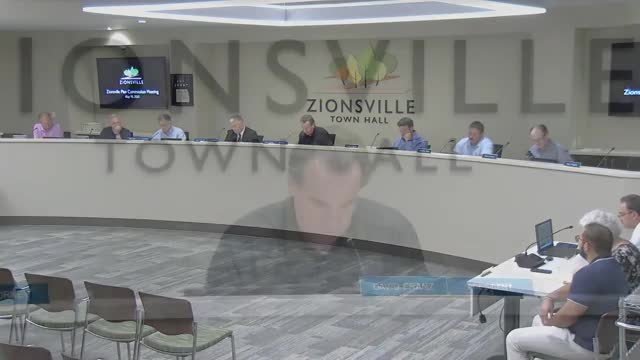
Summary
The Zionsville Plan Commission continued a request from Epcon Communities to rezone about 180 acres for a 55-and-older planned unit development called Courtyards at Heritage Trail after commissioners, staff and neighbors raised questions about traffic, park siting, tree preservation and inconsistent PUD language.
ZIONSVILLE, Ind. — The Zionsville Plan Commission on May 19 continued consideration of a rezoning request from Epcon Communities to convert about 180.75 acres in Worth Township to a planned unit development for an age‑restricted neighborhood called Courtyards at Heritage Trail.
The petitioner seeks a PUD rezoning from rural R‑1 to allow about 362 age‑restricted single‑family homes, a 26‑acre parcel the developer proposes to donate to the town for a public park, and supporting infrastructure. The commission voted to continue the item to the commission’s Aug. 18 meeting to allow staff and the petitioner time to resolve several plan and ordinance inconsistencies and to give neighbors time to review revisions.
The continuation follows a two‑hour presentation and extended public comment period in which Epcon’s land‑acquisition lead, Dale Piper, described the project as a low‑impact, upscale 55+ community with single‑level ranch homes and a copyrighted courtyard product. Piper told the commission Epcon’s consultants prepared a traffic study and a sewer capacity review; he said the company would donate 26 acres for a town park and estimated fiscal benefits including an upfront $4,000,000 land donation, about $1,600,000 in development fees and roughly $2,400,000 in new annual tax revenue, figures he characterized as projections of the project’s public benefit.
Neighbors who spoke at the public hearing raised safety and capacity concerns about County Road 800 East and nearby county roads, questioned the proposed park location, and urged preservation of rural lot sizes and trees. Darcy Stanisek, a resident at 4355 South 800 East, said she visited Epcon’s existing development and expressed concern about the visibility and noise of rear yard central air units, the proximity of homes and the narrow local roads. “The infrastructure roads of Zionsville is a huge concern,” Stanisek said, adding that narrow, winding stretches of County Road 800 East have caused mirror strikes between large vehicles.
Another nearby resident, Alina Klein of 4402 South 800 East, told the commission she appreciated petitioner responsiveness but asked the commission to plan for road safety now, saying, “making a left hand turn is a tough thing to do out of my driveway.” Andrew Cook, 534 Amos Drive, asked the commission to confirm property boundary depictions in notice materials.
Commission discussion focused heavily on technical and drafting issues in the proposed PUD ordinance language and exhibits. Commissioners and staff flagged inconsistent or unclear provisions on setbacks, accessory structures, side‑yard and rear‑yard treatment, buffer widths near the proposed park, whether some exhibit illustrations matched the ordinance text, and how the PUD would treat home‑business rules and zero‑lot‑line details. One commissioner suggested the document should explicitly state whether the project is a zero‑lot‑line product and recommended reconciling illustrations and numeric setbacks so buyers and staff have unambiguous rules to implement.
Commissioners also questioned the park siting. A member said the parcel proposed for donation sits where it would primarily serve Whitestown and would be a drive‑to park for most adjacent Zionsville neighborhoods; the commissioner suggested flipping the park location so it better serves neighboring subdivisions on the east side. The petitioner said the donated land would remain town‑owned and that the town would administer any future decisions on park amenities.
On traffic and sewer, the petitioner said a licensed traffic engineer found the development would generate substantially fewer vehicle trips than a typical neighborhood at the same density — claims the petitioner summarized as 64% fewer weekday trips and 2,200 fewer weekend trips — and that he had funded a sewer capacity study showing sufficient downstream capacity. Several commissioners and residents said they remained concerned about narrow, dark county roads and emergency vehicle operations in the area and asked for more detailed engineering responses and possible mitigation commitments.
Staff recommended continuation to allow the petitioner to redline the PUD ordinance, incorporate clarifying language and exhibits, and provide the commission and the public a clearer, consolidated packet. The commission voted to continue the matter to the Aug. 18 meeting. The roll call recorded six ayes and no nays.
Next steps: staff and the petitioner will meet to resolve inconsistencies in the PUD text and exhibits, clarify setback and buffer language, and republish the revised materials on the town website before the August public hearing.