Get Full Government Meeting Transcripts, Videos, & Alerts Forever!
Get email alerts on the Drainage Master Plan topic
No spam. Unsubscribe anytime.
Tusayan leaders hear drainage master plan update as county, federal partners eye multimillion-dollar mitigation
Summary
Town officials and Coconino County flood-control staff reviewed conceptual watershed and in-town measures to reduce flood risk in Tusayan, noting a $2.4 million planning grant and estimated construction costs of $20 million–$50 million; no final decisions were taken.
Tusayan officials and Coconino County flood-control staff on Tuesday received an update on a drainage master plan that aims to reduce flood risk to the town and key infrastructure, including the wastewater treatment plant and Highway 64.
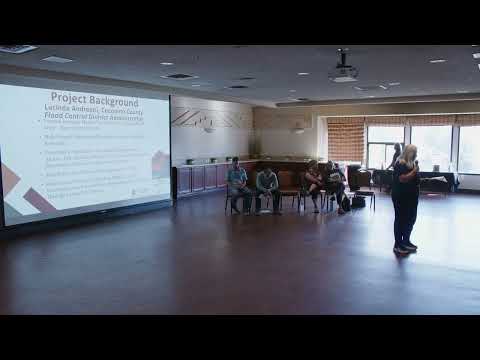
The workshop presentation, led by county flood-control staff and consulting engineers, summarized Phase 1 conceptual alternatives for both upstream watershed measures in the Kaibab National Forest and in-town stormwater conveyance options. Lucinda Andriani, flood control district administrator for Coconino County, said the county secured roughly $2,400,000 in initial planning funds and that construction costs could range from about $20 million to as much as $50 million.
Why it matters: The town faces large peak discharges in a 100-year storm (modeled at roughly 10,000 cubic feet per second). The team said reducing runoff volume upstream is fundamental to making in-town improvements feasible and to protecting critical facilities such as the wastewater treatment plant.
Chris Dusa, the project manager for Civiltech Engineering, described the three-phase project: Phase 1 develops the master drainage plan and identifies conceptual alternatives; Phase 2 produces a design concept report (roughly 30% design); and Phase 3 completes construction documents and permitting (60–100%). He said the team will pursue federal construction grants and that being farther along in design will strengthen grant applications.
Joe Levrich of JE Fuller, the hydrology lead, said the watershed area above the sewer treatment plant is about 60 square miles. He said modeling of the August 2022–23 storm helped calibrate hydrologic models and validate estimated depths and velocities through town, showing the existing FEMA flood-zone mapping is not accurate for current conditions.
Concepts discussed included forest-based detention and retention measures (to slow or store runoff before it reaches town) and a variety of in-town alignments: buried storm drains (largest practical circular pipe in the alignment about 72 inches), arch pipes equivalent to larger diameters, box culverts beneath key roads, and concrete open channels near the wastewater treatment plant. The team said a dual-arch pipe alignment on Coconino Wash could convey roughly 800–1,000 CFS; single 10-by-8-foot box culverts could move about 900 CFS each. The engineers noted that conveying an unmitigated 100-year peak (~10,000 CFS) entirely through town would require an impractically large channel — on the order of 100 feet wide and 6 feet deep — reinforcing the need for upstream measures.
The team reviewed constraints including existing utilities (gravity sewer lines), the number of highway crossings (which increase cost and disruption), environmental and cultural impacts in National Forest and monument lands, water-rights and tribal-rights considerations, and permitting requirements such as the National Environmental Policy Act (NEPA). The Forest Service, Arizona Department of Transportation (ADOT) and other agencies have been engaged; the presenters said they have not yet submitted formal NEPA documents.
Next steps: staff and consultants will narrow the set of preferred alternatives, perform "no adverse impacts" modeling to confirm proposed changes will not shift flood depth or velocity onto other properties, advance to the DCR/30% design stage, and begin detailed permitting and outreach with affected property owners about permanent drainage easements and temporary construction easements. The presenters said part of the grant requirement is submission of a transportation grant application by September 2026.
Votes at a glance: At the start of the meeting the council approved the consent agenda by voice vote; the motion was made by Councilman Josh Calais and seconded by Councilman Greg Brush. Mayor Claire Veil and Councilmen Andrew Aldez, Josh Calais and Greg Brush voted in favor; Council member Elena (newly appointed) was absent.
The presentation and model results will be posted to the flood control district website; the consultants will hold follow-up sessions at tables after the meeting to review concepts with property owners and interested residents. Town officials emphasized the project will require coordinated support from the sanitary district, ADOT, the Forest Service, Coconino County and federal and state elected officials to secure construction funding and complete permitting.