Get Full Government Meeting Transcripts, Videos, & Alerts Forever!
Get email alerts on the Public Transit Funding topic
No spam. Unsubscribe anytime.
Transit operators ask Bonner County for gap funding as Sandpoint shortfall threatens service
Summary
A regional transit provider told Bonner County commissioners it needs one-time and ongoing funding to cover a projected shortfall tied to Sandpoint’s share of service costs and systemwide gaps; commissioners raised legal and equity concerns and asked for more detail before committing county tax dollars.
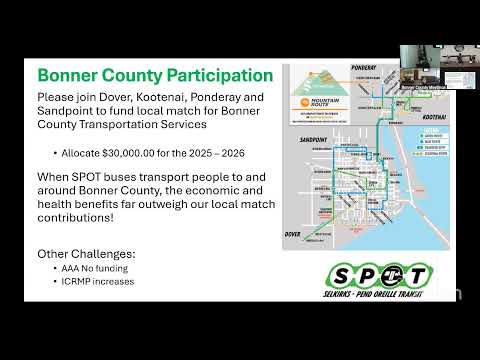
A regional transit provider briefed the Bonner County Board of Commissioners on a budget shortfall and asked for county help to cover gaps after one municipality, the City of Sandpoint, was reported unable to meet its proportional contribution.
The provider said the system carried about 162,914 rides in 2024 across Bonner and Boundary counties and presented a proposed overall budget of roughly $1.28 million. It told commissioners it faces a near-term endpoint shortfall of about $45,000 tied to Sandpoint and an overall system funding gap the presenter described as about $72,000 if advertising and other match options fall short.
The presentation, delivered by agency staff (identified in the meeting transcript by the first name Donna and by the transit board’s leadership listing), summarized operations, ridership breakdowns, funding sources and options. The speaker said the service runs fixed routes 12 hours a day, seven days a week in Bonner County, operates separate funded accounts for Boundary County and Schweitzer Mountain routes, and provides ADA-compliant paratransit curb-to-curb service. Schweitzer Mountain, the presenter said, provides the full local match for its seasonal mountain route and pays match for capital purchases tied to that route.
Why it matters: County funding would shift some costs from municipal partners to the broader county tax base, a step several commissioners said could require legal review and a clear demonstration of countywide benefit. Commissioners emphasized they must be confident spending would benefit a majority of county taxpayers before diverting levy dollars.
Key facts and figures presented - Total reported rides in 2024 (Bonner + Boundary counties): 162,914 (presenter cited this figure as the system total). - Proposed budget: presenter cited $1,284,897 and also read $1,284,887 (two close figures were spoken in the presentation). - Advertising budget under development: $36,000 (not guaranteed; presenter described active efforts to sell ad space and sponsorships). - Endpoint shortfall tied to Sandpoint: approximately $45,000 as isolated to an endpoint; presenter also said the system-wide shortfall remains larger (presenter cited roughly $72,000 short if advertising goals are not met). - Demographic breakdown (as reported by presenter, based on drivers’ hand counts and visual observation): seniors ~39,000 rides; riders with disabilities ~4,600; youth ~16,400; general public ~103,000. The presenter said these demographic counts are approximate observations by drivers and were rounded.
Options discussed by presenters and commenters - Maintain free fares (current model): Presenter and board members argued fares slow service, raise operating and vendor costs, introduce cash-handling security concerns and can reduce eligibility for federal match calculations. - Start a low fare (examples cited): Cliff Warren, a county resident who spoke during the meeting, said a $1 fare might generate about $60,000 but added that system costs (card readers, vendor fees, administration) would substantially reduce net revenue. Warren said instituting fares could reduce ridership and overall system effectiveness. - Increase local sponsorship and advertising: The operator said it is pursuing advertising revenue and local sponsorships (including outreach to larger businesses such as Walmart) and has budgeted $36,000 for advertising as a match strategy. - Reduce service in the affected municipal area if the municipal partner cannot cover its share: presenters said service reductions in Sandpoint would be considered if the city cannot address its funding gap.
Commissioners’ concerns and next steps Commissioners repeatedly said they need proof of countywide benefit and legal authority before allocating county tax dollars to a third-party transit provider. One commissioner summarized the county’s position: “I have to be very responsible. And if I can't see a benefit to the majority or the super majority of the county, I can't put my name on that.” Another commissioner raised a statutory question about Idaho Code (spoken in the meeting as “Idaho statute 30 one-eight 76”), saying the language appeared to authorize a county to operate and fund a public transportation service but raised doubt about using levy dollars to fund a third-party system; that commissioner said they had not yet received a formal legal opinion.
No formal county action or vote was taken during the presentation. Commissioners asked the transit provider to return with clearer accounting, documentation of how county funds would be applied across the system (not only to Sandpoint), and any required legal opinions about county authority to fund a third-party transit operator.
Context and constraints noted by the operator The presenter stressed that most federal funds channel through the Idaho Public Transit Office and that Federal Transit Administration (FTA) and Americans with Disabilities Act (ADA) requirements affect service design and match obligations. The presenter described the system as lean, heavily dependent on volunteer hours for local match, and facing higher-than-usual maintenance costs because many vehicles have high mileage. The presenter also noted the system competes for grants on a biennial cycle for operating and capital funding and occasionally receives one-time funds.
Ending: The commissioners did not commit county funds at the meeting. They directed further information be provided, including legal review and more detailed accounting of where any county contribution would be applied across the transit system.