Get Full Government Meeting Transcripts, Videos, & Alerts Forever!
Get email alerts on the Property Maintenance topic
No spam. Unsubscribe anytime.
Guam hearing advances plan to adopt International Property Maintenance Code for Tumon hotel zone
Summary
The Committee on Land, Environment, Housing, Agriculture, Parks and Infrastructure heard July 25 testimony on Bill 160-38 COR to enable adoption of an International Property Maintenance Code for certain hotel‑zone properties in Tumon, with proponents urging a faster effective date and regulatory development.
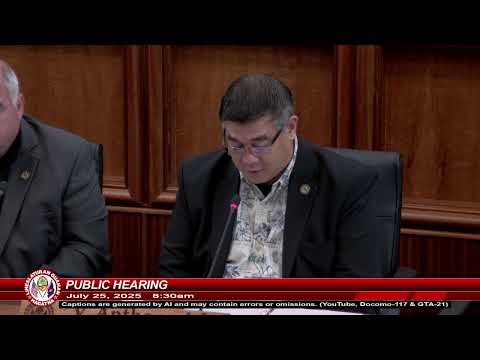
HAGATNA, Guam — Legislators on the Committee on Land, Environment, Housing, Agriculture, Parks and Infrastructure heard testimony July 25 on Bill 160-38 COR, which would add a new Article 8 to Chapter 66, Title 21, Guam Code Annotated to allow adoption of the International Property Maintenance Code (IPMC) for certain hotel‑zone properties.
Jerry Perez, vice president of the Guam Visitors Bureau, and Dan Swavely, a Tumon resident and former GVB destination‑development committee member, testified in favor, saying the measure would improve safety and visitor impressions in Guam's resort district. "First impressions matter," Perez said in his written statement submitted for the record. He recommended amending the bill so it would take effect 90 days after enactment rather than one year.
Swavely described a draft set of standards he prepared using the IPMC as a template and recommended the administrative adoption process. He said his draft — created while working with GVB prior to 2020 — covered sidewalks, walkways, stairs, driveways and parking; exterior premises free from overgrowth; rodent‑ and pest‑control standards; accessory structures and fences in good repair; limits for peeling or flaking paint and mold (he recommended a 10% threshold for repair or repainting in his draft); and procedures for notice and correction. "If a property owner cannot budget routine maintenance to repair, repaint, or mow the grass, it will not bother to pay a fine," Swavely said, and he recommended suspension of a property owner's business license as an enforcement tool rather than only a monetary penalty.
Context and process: Swavely and GVB recommended putting detailed standards into regulation so they can be revised through rulemaking. He said a cross‑sector task force (GVB, Guam Mayors' Council, Fire Department, Public Works and two tourism industry representatives) should vet the standards before adoption. He also noted the Guam Building Code Council had been inactive and would need to be mobilized to assist with the regulatory process.
Several senators expressed support for improving tourism‑district appearance but raised concerns about unintended consequences. Committee members asked whether the law would reach large derelict structures — such as the Verona and Pacific Star properties discussed during questioning — and were told those cases typically require separate legal processes beyond routine maintenance enforcement. Senators also urged caution about imposing penalties on small businesses and requested DPW input on implementation feasibility and staffing.
The committee did not vote. Members said they will schedule markups, invite DPW testimony, and consider recommended changes including a shortened effective date and mechanisms for owner assistance or incentives. The committee also opened the record to accept written statements on the hearing for seven days.
The hearing included requests that regulations be tailored to Guam conditions (for example, removing climate‑specific provisions such as snow removal) and that the regulatory metrics be explicit (e.g., percent of surface with peeling paint that triggers a violation). Proponents said a locally reviewed IPMC could be amended over time through the regulatory process to fit Guam's climate and market realities.