Get Full Government Meeting Transcripts, Videos, & Alerts Forever!
Get email alerts on the Transit Reliability Smart Grant topic
No spam. Unsubscribe anytime.
MTA board authorizes SMART grant contracts to test signal priority and real‑time tools on Murfreesboro Pike
Summary
The Nashville MTA board approved contracts funded by a U.S. DOT SMART grant to pilot technologies aimed at reducing bus bunching and improving reliability on Murfreesboro Pike; contracts include Vanderbilt University, Synwaves (doing business as LYT), and Metro Nashville DOT.
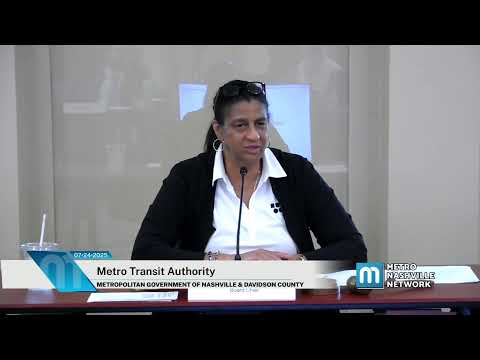
MTA board members on Thursday approved a set of contracts tied to a federal SMART (Strengthening Mobility and Revolutionizing Transportation) grant to pilot transit signal priority, traffic‑adaptive signals and real‑time vehicle‑spacing tools on Murfreesboro Pike. Dan Freudberg, a WeGo staff member who presented the project to the Operations and Finance Committee, said the effort is designed to reduce “instances of people having to wait extended periods of times for buses when we promise them a bus every 10 minutes and they end up having to wait 20 or 30 minutes.” The board approved three principal agreements that require board authorization: a $766,533, 24‑month contract with Vanderbilt University (with Penn State as a subcontractor) tied to the SMART grant; a separate not‑to‑exceed five‑year agreement with Vanderbilt for additional task‑based services valued at $1,735,380; a $417,720, 24‑month contract with Synwaves (doing business as LYT) for transit signal priority services; and a $744,896, 24‑month contract with Metro Nashville Department of Transportation and Multimodal Infrastructure for traffic adaptive signal control work. Those contract values include a 20% contingency accounted for in the overall SMART project budget. Freudberg said the project will pair several technology and research partners — including Vanderbilt, Penn State, LYT (transit signal priority), Miovision (signal controller technology via Metro DOT), Transit App, Swiftly and the vendor March Networks — to give dispatchers and drivers real‑time views of vehicle spacing and tools to intervene when buses bunch. He described a cloud‑based, largely hardwareless approach that will use existing CatAVL data and cloud services to send instructions to traffic controllers and operators. Board members asked whether the university work will integrate with WeGo’s enterprise asset management and predictive maintenance systems; Freudberg said databases will remain separate but data can be merged and shared across initiatives. He also said the 24‑month contracts are intended as a Stage‑1 testbed; lessons learned could support a larger Stage‑2 application or expansion to other corridors. The Operations and Finance Committee recommended approval and the full board voted unanimously to adopt the contracts. The motion to approve was made by Miss Dolphin (Operations and Finance Committee chair) and seconded by Jeff Hames; Chair Gail Williams called the vote and the motion carried. The board directed staff to proceed under the grant terms and to evaluate outcomes; no additional board directives or amendments were recorded at the meeting. Less critical details: the SMART grant project will prioritize buses that are falling behind relative to vehicle spacing rather than simple schedule adherence, and staff said transit signal priority may modestly improve travel speeds while primarily addressing reliability. Evaluation metrics and any later procurement for durable systemwide deployment were not specified at the meeting.