Get Full Government Meeting Transcripts, Videos, & Alerts Forever!
Get email alerts on the Beach Management Funding topic
No spam. Unsubscribe anytime.
Flagler County lays out options for beach renourishment funding; city officials ask for clearer cost breakdowns
Summary
County staff presented a beach management plan and financing options including city-led assessment, county MSBU/MSTU, dedicated millage or a half-cent sales tax referendum; city commissioners asked for more data on costs and asked the county to clarify the earlier plan.
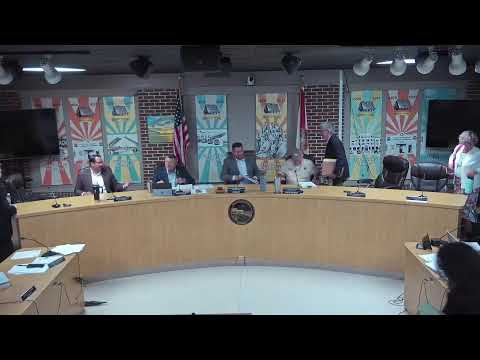
Flagler County officials on July 22 updated the Flagler Beach City Commission on the county’s Beach Management Plan and funding options for initial construction and ongoing renourishment, emphasizing that local match funding will be required and presenting a menu of possible funding mechanisms.
Kim Carney, Flagler County commissioner (District 3), and Jorge Salinas, deputy county administrator, presented the county’s plan and funding picture, which the county says now requires local shares to finish portions of the coastline not covered by federal work. County staff said the Army Corps’ Reach 1 project (completed September 2024) covered a federal reach but that Reach 2 — the portion north of Seventh Street and a southern 1.6-mile section to the Volusia County line — still requires local matching funds. The county reported an initial construction shortfall and projected annualized renourishment local-match needs for the Flagler Beach portions of roughly $1.14 million when amortized on a six-year cycle at the county consultant’s assumed nourishment rate.
County staff presented five high-level options for raising local share revenue: (1) a city-established special assessment (MSBU) requiring an engineering study to allocate costs by parcel; (2) a city-dedicated millage; (3) a coordinated county half-cent sales-tax referendum (November 2026); (4) a county-established assessment that includes city consent; and (5) a county Municipal Service Taxing Unit (MSTU). The county said each approach has tradeoffs: a city-led assessment gives local control but requires legal work and outreach; an MSTU is administratively simpler and does not require an engineering study but counts against existing millage caps.
Commissioners repeatedly asked for more transparent numbers and a clearer plan. Commissioner Cooley said he’d seen an earlier funding presentation that included a half-cent sales tax and an equitable per-parcel distribution; he said the options shown at the meeting lacked the level of detail the commission previously reviewed and asked staff for more specific cost comparisons. Commissioner Spradley and others asked whether the county board had decided which mechanism it preferred; county representatives said no single option had been selected and that the $8.1 million the county plans to dedicate in FY26 was cobbled together from multiple sources (a portion of the county’s half-cent sales tax, TDC allocations, a 0.2 mill county dedication and carryover funds).
County coastal engineers said the plan models two phases — initial construction and periodic renourishment — and noted that monitoring and actual fill needs could change. County staff warned the commission that renourishment volumes could increase if monitoring shows higher sand losses; they also clarified that FDEP, FEMA and the Army Corps may participate in specific projects and that costs and matches vary depending on the funding mix.
No formal action was taken; commissioners asked county staff to return with more detailed cost allocations and asked the city manager and commissioners to coordinate on whether the city should pursue a city-led assessment, consent to a county MSBU, support the half-cent sales tax referendum or pursue other mechanisms. Several members asked County Commissioner Carney to advocate for the original plan the commission had reviewed earlier in the county process.