Get Full Government Meeting Transcripts, Videos, & Alerts Forever!
Get email alerts on the Transportation topic
No spam. Unsubscribe anytime.
Miami Beach presents traffic study to seek permanent permit for one-way Ocean Drive; residents and businesses raise safety and economic concerns
Summary
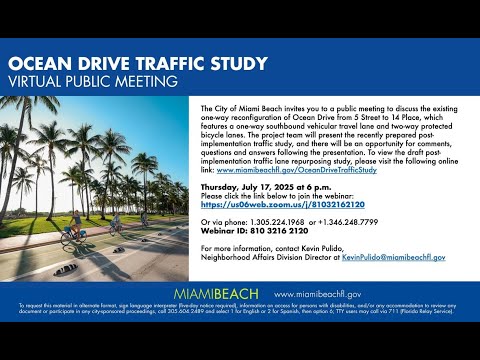
City of Miami Beach transportation officials and consultants on June 17 presented a traffic impact evaluation to Miami‑Dade County seeking permanent approval of the current one‑way southbound vehicle configuration and a bidirectional protected bicycle lane on Ocean Drive.
City of Miami Beach transportation officials and consultants on June 17 presented a traffic impact evaluation to Miami‑Dade County seeking permanent approval of the current one‑way southbound vehicle configuration and a bidirectional protected bicycle lane on Ocean Drive. The study concluded the lane repurposing produced no adverse traffic impacts at analyzed intersections and in many cases improved side‑street operations.
The presentation, led by Assistant Director Julio Rodriguez of the Transportation and Mobility Department and Jenna Martinetti of Calvin Giordano & Associates, summarized an 800‑page traffic study submitted to Miami‑Dade County as part of a permitting process required under Section 334.61 of the Florida Statutes. Rodriguez said the study compares the 2019 two‑way configuration to the current one‑way configuration and that Miami‑Dade County has conditioned approval while the city pursues permanent permitting.
The study focused on traffic engineering metrics such as intersection delay and level of service during noon and evening peak hours. Martinetti said the analysis found “no negative impacts to the vehicular flow on Ocean Drive or the surrounding intersections,” and that the one‑way layout reduced vehicle conflicts by eliminating opposing left‑turn movements. The presentation also noted the protected bicycle lane provides “enhanced and improved safety and mobility” for bicyclists and pedestrians.
The meeting drew questions and objections from residents, business owners and a state legislator about topics the traffic study did not address. Lorenzo Borghese, owner of South Beach Brewing, said he did not have the study until the day of the meeting and asked where an economic analysis of business impacts could be found. “Bicyclists are not customers. They’re out there getting exercise,” Borghese said.
Henry Stoller, a full‑time resident at 1500 Ocean Drive, and David Wallach of 900 Ocean Drive both argued the study failed to meet the statutory requirement to “address any potential adverse impacts of the project,” contending the city omitted safety, economic and other non‑operational impacts. Stoller said the study’s scope was “completely contrary to statute.” Wallach cited personal incidents he said resulted in hospital visits and asked why a safety study or injury statistics were not included.
State Representative Fabian Basabe said he spoke with the Florida Department of Transportation and that FDOT had expressed preliminary concerns about impacts to state roads and alleyways the city might use as part of new traffic patterns. Basabe said his chief concerns were public safety, tourism and the economic health of small businesses.
City staff and consultants responded that Miami‑Dade County required an operational traffic engineering analysis for permitting under the county’s implementation of Section 334.61 and that the county did not require an economic or separate safety study for this permit. Assistant Director Julio Rodriguez said the county’s permit process prescribes a traffic engineering analysis, not an economic analysis. The presentation team also noted the city has a separate program to install bicycle counters and that a counter location for Ocean Drive is scheduled for installation in early July.
Several callers asked why the one‑way flow was southbound rather than northbound; Andres Acion and others suggested a northbound one‑way would better serve tourist traffic arriving from I‑395. Rodriguez and the presentation team said the current configuration follows a feasibility study completed in late 2019 and a city commission direction to reopen Ocean Drive to vehicular traffic in the one‑way southbound configuration at a commission meeting on Oct. 27, 2021.
Other participants urged restoration of the prior promenade pilot program. Jane Krupp, a resident at 1390 Ocean Drive, noted the city commission had previously discussed a long‑term vision to pedestrianize Ocean Drive north of Fifth Street and asked why the promenade pilot was not restored as part of permitting; city staff said the promenade and the county’s operational concerns are a separate topic from the 2021 permit request being reviewed tonight.
The city reported outreach steps taken to comply with notice requirements in Section 334.61: a March 7 mailing to a quarter‑mile radius that officials said reached more than 5,500 addresses and a second mailing on June 17; the city said it also published notices in local media and posted information online. Rodriguez said that, if the city proceeds, it must notify affected property owners at least 180 days before design completion; staff said that 180‑day window ends Sept. 3 for this project.
No formal vote was taken at the public meeting. City staff said the traffic study is under review by Miami‑Dade County and that the city has submitted multiple revisions in response to county comments and expects further comments or final action in the coming weeks. Staff also noted plans to install bicycle counters to collect usage data beginning next month.
The public meeting recording and the full traffic study are available from the City of Miami Beach; city staff gave a web address at the meeting for the traffic study. The city said the meeting transcript and materials will be posted; the presentation team said they will continue to work with Miami‑Dade County on permit comments and to respond to public questions raised at the meeting.