Get Full Government Meeting Transcripts, Videos, & Alerts Forever!
Get email alerts on the State Budget topic
No spam. Unsubscribe anytime.
House approves FY2026 spending plan, agrees to Senate amendments including $1.2 billion from stabilization fund
Summary
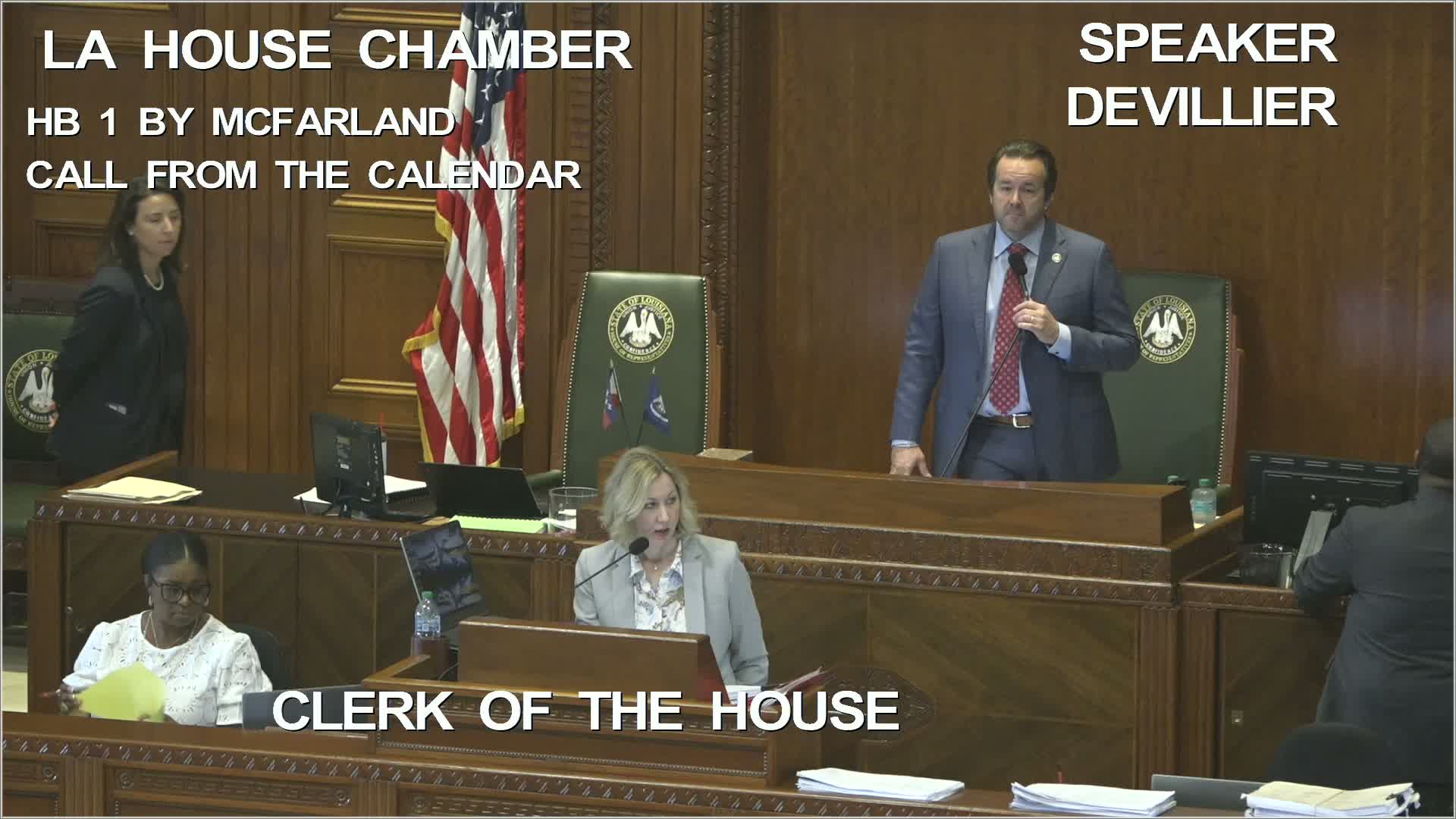
The Louisiana House on June 11, 2025 agreed to Senate changes to House Bill 1, the annual appropriations bill for fiscal 2025–26, using one-time Revenue Stabilization Trust Fund money for infrastructure and other one‑time projects while restoring several program increases from the Senate.
The Louisiana House of Representatives on June 11, 2025 agreed to Senate amendments to House Bill 1, the bill making annual appropriations for fiscal year 2025–26, moving the state’s budget process closer to completion.
Representative Brett McFarland, who carried the bill on the House floor, outlined Senate changes that increased certain expenditures and used $1.2 billion from the Revenue Stabilization Trust Fund for one‑time items. "I ask for your favorable passage," McFarland said as he closed debate.
The Senate additions included restorations and new amounts the House version did not contain: $30,000,000 restored for tutoring services in the Department of Education; roughly $46,400,000 for various higher education institutions; $15,300,000 for a facility in Baton Rouge to house criminal defendants found incompetent to stand trial; $11,600,000 to increase the local per‑diem for housing adult defendants in local jails; $8,300,000 to the Louisiana Department of Health for a new Medicaid eligibility and enrollment module; and $5,000,000 to the Department of Children and Family Services for child‑welfare expenses. Representative McFarland also described $709,000,000 directed to the Louisiana Transportation Infrastructure Fund and additional one‑time allocations for economic development, water projects, campus revitalization, criminal justice and first responders, and voting technology, all paid from the stabilization fund.
During floor questions, Representative McCormick pressed for clarity on the so‑called "Gator" scholarship funding. Representative McFarland said the Senate reduced the Gator Scholarship allocation from $93,000,000 to $50,800,000 and used portions of that difference to backfill high‑dosage tutoring and other items. "So originally, the total was 93,000,000. They reduced to 50,800,000," McFarland said on the floor when restating the change.
Members asked multiple technical questions about how one‑time stabilization dollars would be recognized and which parts of the budget are recurring versus one‑time. McFarland said the state general fund would not increase beyond what the Revenue Estimating Conference recognized and emphasized that most of the $1.2 billion from the stabilization fund is being used for one‑time projects.
The bill received a favorable vote on the House floor; the clerk recorded at least one recorded no vote during the machine vote and the House accepted the Senate amendments.
The House debate made a point of distinguishing recurring base spending from the one‑time uses of stabilization funds; members noted that using one‑time trust funds for recurring expenses would create future budget pressure if not paired with other offsets.
What this means: HB1 establishes the state’s spending plan for the coming fiscal year and allocates substantial one‑time resources from the Revenue Stabilization Trust Fund to infrastructure, higher education projects, and other nonrecurring needs. Restored items adopted in the Senate version include tutoring funds, higher‑education maintenance, a facility for defendants found incompetent to stand trial, and investments in Medicaid eligibility systems.
Next steps: The House concurrence with Senate amendments moves the budget process forward; the bill’s final posture depends on subsequent enrollment and any further procedural steps required before enactment.