Get Full Government Meeting Transcripts, Videos, & Alerts Forever!
Get email alerts on the Firearm Storage Child Safety topic
No spam. Unsubscribe anytime.
Louisiana House rejects child-access prevention bill for firearm storage after hourslong debate
Summary
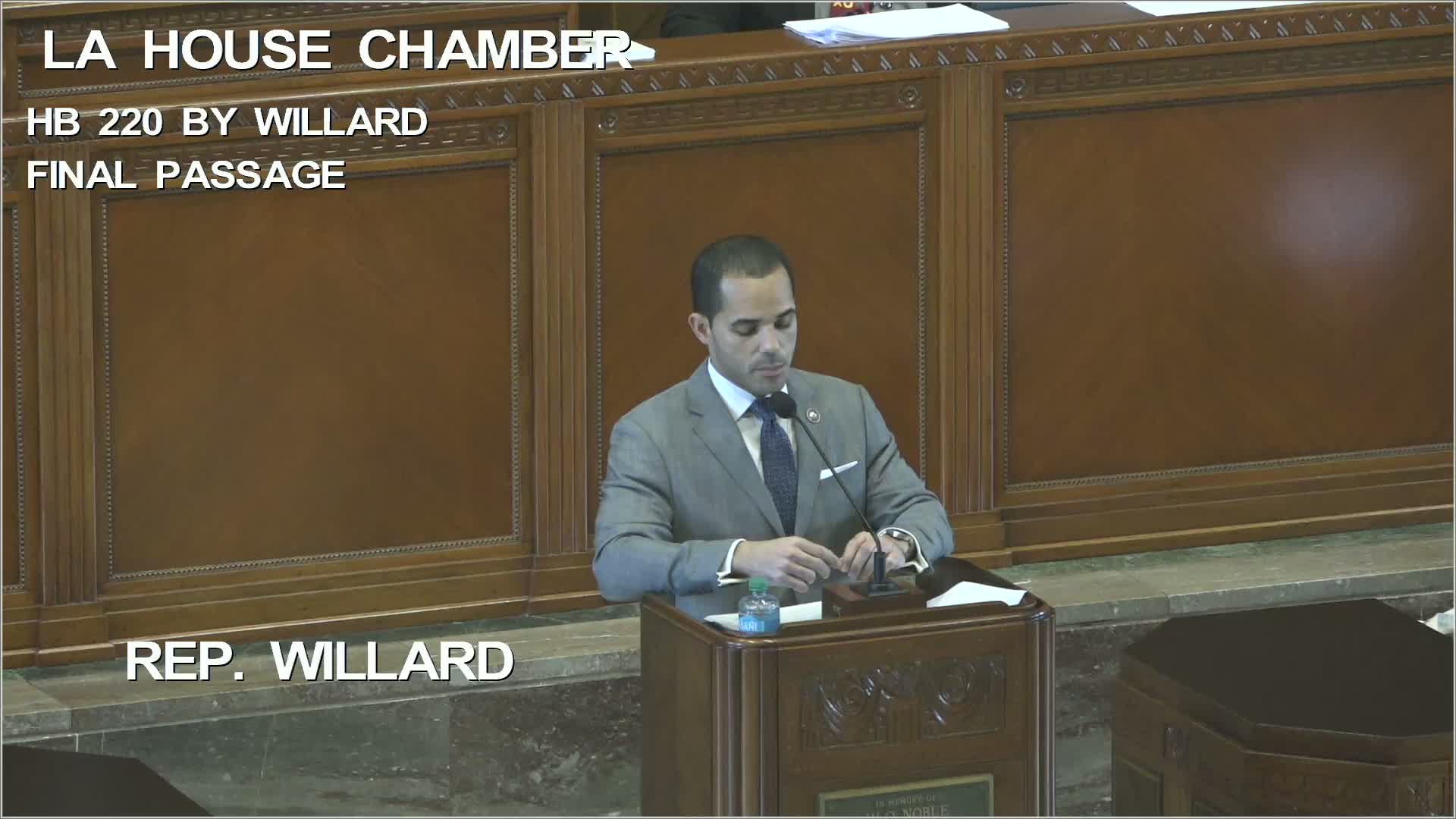
A proposal to create a misdemeanor for unsecured, loaded firearms accessible to children failed in the House after extended debate over scope, exemptions and enforcement. The measure, HB220 by Rep. Alan Willard, drew amendments narrowing coverage and a named dedication but was defeated 39-46 on a final passage motion.
BATON ROUGE — The Louisiana House of Representatives voted down a proposed law that would penalize adults whose loaded firearms were accessible to minors and then used in public or to harm someone. Representative Alan Willard introduced House Bill 220 as a child-safety measure aimed at reducing accidental shootings by minors. The final motion to pass the bill failed 39-46.
Willard said the measure was narrowly targeted and would not “impede anybody’s ability to carry their firearm,” but would “implement what is known as a child access prevention law,” adding that Louisiana had “the highest rate of unintentional shootings by children.” He told colleagues the bill combined education, tax incentives and a legal backstop to reduce those incidents.
Supporters framed the bill as a public-safety and child-protection law. Representative John Furman, who spoke in favor, urged colleagues to consider the faces and stories of children killed in accidental shootings, and Representative Chasson and others said the proposal aimed to prevent easy access by younger children.
Opponents raised constitutional and enforcement concerns. Representative Malcolm Clark and others argued the measure risked infringing on lawful gun ownership and could expose responsible parents to prosecution for unlikely, ambiguous scenarios. Lawmakers repeatedly asked how the statute would apply in common fact patterns — for example, when a homeowner stores an unloaded firearm in a nightstand, or when a child uses a gun in defense of a dwelling after an intruder enters — and whether police or prosecutors could exercise discretion.
The bill included several amendments before the final vote. Lawmakers narrowed the covered age to children 13 and younger in a floor amendment offered by Rep. Jack Villio and added a provision to name the law in memory of Noah Carraway, a child described in committee testimony. Willard said panel testimony and consultations prompted technical clarifications, including definitions of public places and a seven‑day waiting period for certain prosecutions to allow families to grieve and for investigations to proceed.
Law-enforcement witnesses and public-health groups supported the measure in committee, saying existing criminal categories — such as negligent injury or cruelty to juveniles — do not always allow prosecutors to address dangerous storage cases. Supporters pointed to United Way–compiled statistics showing a higher rate of unintentional child-involved shootings in Louisiana than in neighboring states.
Several members sought additional data on whether similar laws in other states had produced measurable declines in child-involved shootings. Willard cited broad evidence and pointed to Texas and Florida as examples of states with child-access laws and comparatively lower rates in the specific dataset presented in committee.
Final action: Representative Willard moved for final passage; the clerk recorded 39 yeas and 46 nays and the bill failed to pass. Multiple speakers said they would continue to work on the issue, but as of the vote HB220 did not advance.
Why it matters: Supporters described HB220 as a narrowly tailored child-safety measure; critics said it risked unintended legal exposure for responsible gun owners. The debate highlighted the balance lawmakers attempted to strike between gun rights and preventing accidental shootings by minors.