Get Full Government Meeting Transcripts, Videos, & Alerts Forever!
Get email alerts on the Reproductive Rights Ivf topic
No spam. Unsubscribe anytime.
House rejects 'biological human' amendment and advances IVF protection bill after hours of debate
Summary
Lawmakers debated Senate Bill 156 — a measure to regulate ownership, destruction and rights around in vitro fertilized embryos — and rejected an amendment that would have called embryos "biological human beings." Several amendments were adopted; the bill advanced with co‑authors.
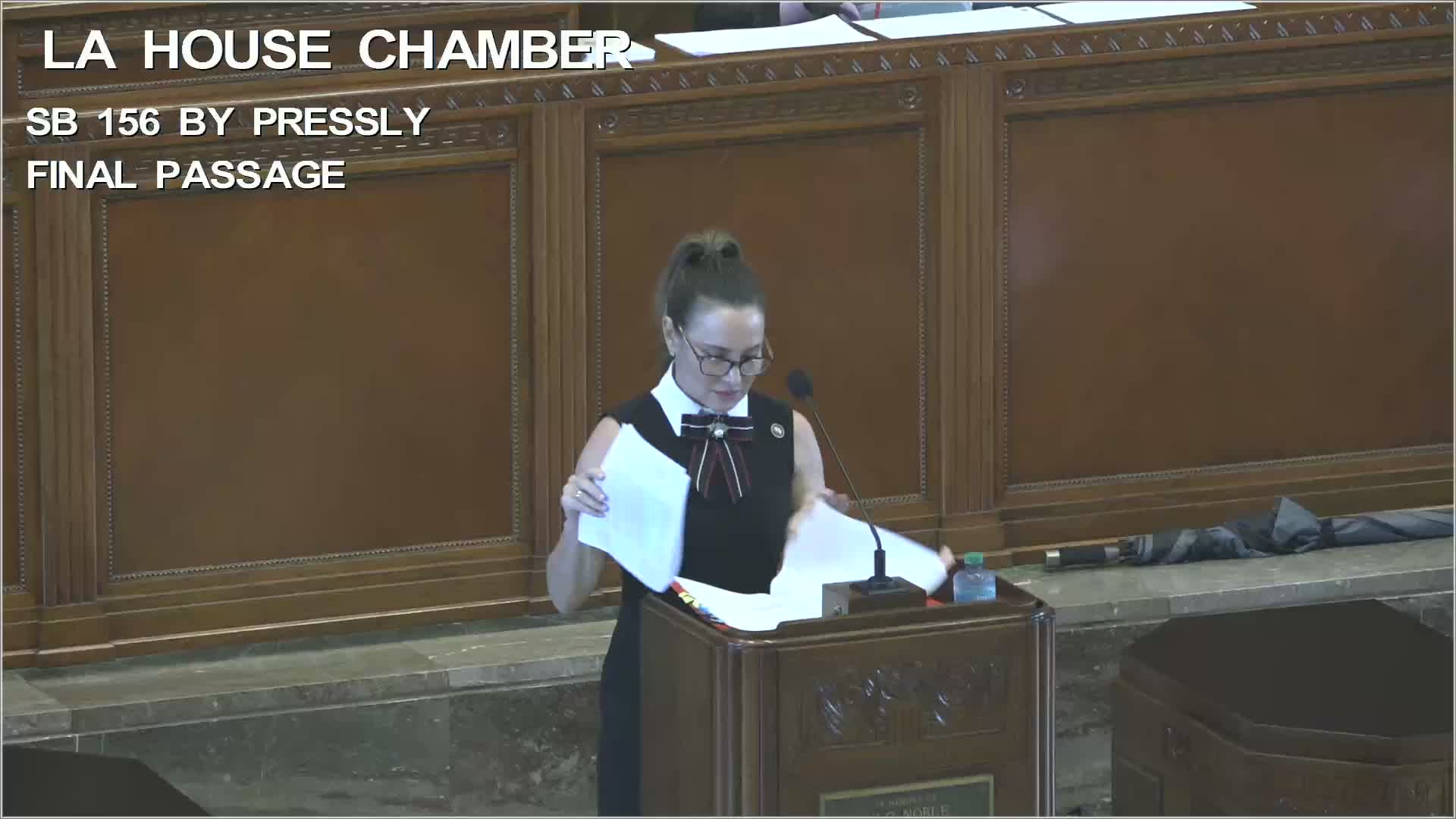
The Louisiana House spent a prolonged session debating Senate Bill 156 on May 27 — a measure that frames legal protections and ownership rules for in‑vitro fertilized embryos used in assisted reproduction.
Representative Sam Davis, speaking for the bill on the House floor, described the measure as aimed at protecting families who rely on in‑vitro fertilization (IVF) and aligning state law "with medical science," while also carving out protections for providers and parents. Davis said the text had been negotiated with several interested parties, including advocacy groups and religious organizations, and that some technical amendments proposed by stakeholders had been accepted.
A contentious amendment offered by Representative Amade would have added the phrase "an in vitro fertilized human embryo is a biological human being not susceptible of ownership" to the statute’s text. Proponents of the amendment said the language recognizes the embryo’s biological status; opponents, including the bill’s floor sponsor, argued the wording risked subjecting IVF practices and providers to criminal penalties under existing criminal statutes. Representative Davis noted the bill already includes language agreed with conservative senators and interest groups that describes an embryo as "biologically human" in a defined context; the Amade wording was framed by some as broader and potentially legally consequential.
The Amade amendment failed on a recorded vote, 15 yeas to 73 nays. Representatives who spoke in opposition warned the proposed wording could criminalize common fertility practices; supporters of the amendment said they sought moral clarity.
Other amendments made by House members clarified the definition of non‑viable embryos and the process for transferring legal rights to donated eggs and embryos. Davis said those technical changes were intended to reduce legal uncertainty for parents and providers.
Lawmakers also debated whether single persons or surviving spouses would be able to use IVF; Representative Davis said the bill’s use of the terms "parent or parents" does not, in his view, exclude single parents and that the floor had not received floor notes indicating otherwise.
Why it matters: SB 156 addresses legal questions — ownership, custody, destruction and post‑fertilization consent — that affect patients, fertility clinics and providers. Amendments sought to adjust medical, civil and criminal implications of the bill; the House rejected language opponents warned could criminalize standard IVF practices.
What's next: After the House vote on amendments and final consideration, the bill moved forward with co‑authors recorded on the floor. The record shows co‑sponsorship counts and the bill’s language will be subject to any further action required by the Senate for final enactment.