Get Full Government Meeting Transcripts, Videos, & Alerts Forever!
Get email alerts on the Redistricting topic
No spam. Unsubscribe anytime.
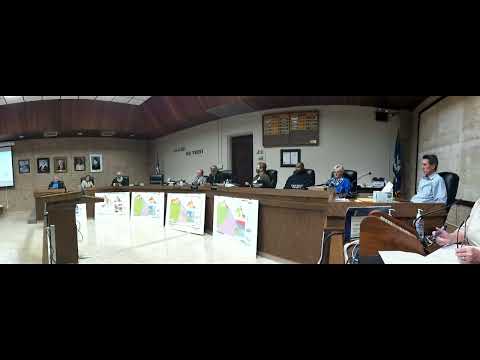
School board adopts resolution to establish election districts under ‘Alternative 1‑A’
Summary
At a special meeting Feb. 15, 2002, the parish school board adopted a resolution labeled Alternative 1‑A to establish and define school board election districts; two members objected and one member was absent. Board members said the plan aligns with a parish council proposal and noted declining minority percentages in some districts.
At a special Parish School Board meeting Feb. 15, 2002, the board adopted a resolution — referred to in the meeting as “Alternative 1‑A” — to establish and define school board election districts, the board president announced.
The measure matters because board members said the proposed districts mirror a recent proposal from the parish council and because several members raised concerns about minority representation in future elections.
School board member Matthew Ford, who moved the recommendation, said the committee and the council had shown “an overwhelming interest in everyone having the same districts for school board and parish council.” Ford urged the board to approve the plan to encourage the council to take the same approach.
Another board member (identified in the transcript as Miss Pinoy) acknowledged that some people think the plan is not ideal but said there were “no alternatives” available that met federal requirements: “I just like to add that, I think that we have some folks that think this is not the best or the most bridal, plan to implement, but there really are no alternatives.”
The motion was made by School board member Matthew Ford and seconded by School board member Clyde Hamner. When the vote was counted, the board president announced, “All votes are in. 2 objections, Mister Harding and Mister Lagarde. Absent, Mister Roger DeHart,” indicating the motion passed despite two votes against it.
During discussion, a board member raised concerns about declining minority participation in at least one district, saying their district’s minority percentage had fallen “from 52 to 50%” and recalling that when they first joined the board “23, 24 years ago” the district was in the mid‑50s (given as “54, 55, and 6%” in the record). That member said the board may need to consider how to address representation in the future, perhaps in about 10 years, but did not set a specific timeline or directive.
There were no recorded amendments to the resolution during the meeting. The transcript shows no formal motion to refer the matter for further study; the board’s action at the meeting was adoption of the resolution.
The board did not, during this meeting, set a timetable for implementing changes related to minority representation or direct staff to prepare follow‑up reports; those matters were discussed only as concerns and possible future considerations.