Get Full Government Meeting Transcripts, Videos, & Alerts Forever!
Get email alerts on the Criminal Justice topic
No spam. Unsubscribe anytime.
House fails to pass criminal-procedure bill after recorded votes and reconsideration
Summary
House Bill 4506, a bill to amend the code of criminal procedure, was advanced to third reading and debated on the floor; the House recorded votes that the clerk announced as favorable counts but the presiding officer declared the bill not passed after two recorded tallies.
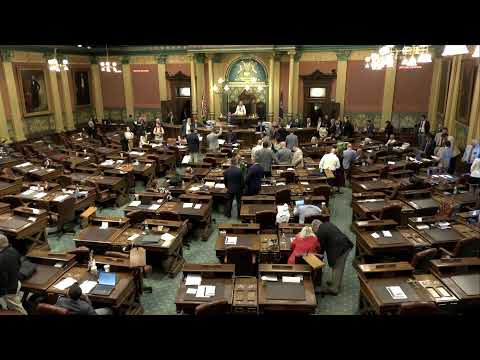
House Bill 4506, a proposal to amend the Michigan Code of Criminal Procedure, was taken up on the House floor and advanced to third reading. Representative Leitner spoke in support saying the bill "allows prosecutors to continue to ask for life without parole" and argued it preserved prosecutorial options. Floor substitutes and amendments were considered and the House held recorded roll-call votes on final passage.
The clerk announced a first recorded tally of 55 aye and 42 nay on final passage; the presiding officer then stated the bill had not passed. The majority floor leader moved to reconsider the vote, and the House later retook the question. After extended enforcement of rule 31 and multiple board closings and reopenings, the clerk recorded a subsequent tally of 55 aye and 43 nay; again, the presiding officer said the bill had not passed.
The transcript records adoption of at least one amendment on third reading prior to the final vote. Representative Leitner addressed the chamber in support of the bill and said it was necessary for prosecutors and victims under time pressure following a Michigan Supreme Court ruling; Representative Lightner was listed as the bill’s sponsor at introduction. The transcript does not include additional procedural explanation in the floor record explaining why the speaker declared the bill not passed despite the numerical tallies announced by the clerk.
The House gaveled repeated board closures and enforcement of Rule 31 during the recorded-vote process. After the final announced tally the clerk reported the numbers and the presiding officer ruled the bill had not passed; the transcript does not record further action on the bill that day.