Get Full Government Meeting Transcripts, Videos, & Alerts Forever!
Get email alerts on the Student Discipline topic
No spam. Unsubscribe anytime.
Tangipahoa Parish policy committee reviews 2025–26 student conduct procedures, debates stricter vaping discipline
Summary
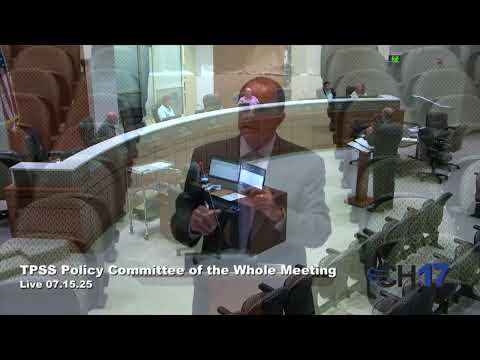
The Tangipahoa Parish Policy Committee of the Whole reviewed the 2025–26 TPSS Student Code of Conduct procedural manual at its July 15 meeting, with board members debating stricter penalties for student vaping and administrators summarizing how discipline, appeals and transfers will be handled under the revised procedures.
The Tangipahoa Parish Policy Committee of the Whole reviewed the 2025–26 TPSS Student Code of Conduct procedural manual at its July 15 meeting, with board members debating stricter penalties for student vaping and administrators summarizing how discipline, appeals and transfers will be handled under the revised procedures.
The manual, presented by Ron Jenko, staff member, outlines the district’s step-by-step Discipline Review Committee (DRC) process, Chromebook handling for students awaiting alternative placement, and appeal routes to the superintendent or board. "What you have in front of you is the document that our administrators will use as they are presented with issues that come to them from classroom, bus discipline, etcetera," Jenko said. He described a back section intended as a quick-reference, with hyperlinks to procedural steps and to the DRC workflow.
Why it matters: the procedural manual defines day-to-day enforcement tools used by principals and school staff, while any change to the district’s formal vaping consequences will require referral to the board’s policy process. Those decisions affect student attendance, placement and parental appeal rights across Tangipahoa Parish schools.
Key points from the meeting
- Chromebook and DRC procedures: Jenko said when a student is recommended for a change of placement the DRC process is spelled out from the recommendation through appeal. Parents who sign for a Chromebook for a student waiting placement must return it at the DRC meeting; if they do not, the district may assess a fine or require full payment for replacement. Jenko said the district will allow students waiting on a DRC placement to keep up with schoolwork, but the Chromebook must be returned at the DRC or fines/repayment apply. He also said parents have a one-time request option to the superintendent or designee to reschedule a DRC hearing if a legitimate reason prevents attendance.
- Appeals and alternative-school registration: The revised procedures say a parent may not make an appeal unless the student is registered and in good standing with the alternative school; the board member who led the vaping-policy push said the change is meant to prevent appeals from families whose students never attend the alternative campus.
- Vaping enforcement and penalties: A board member (name not specified) urged the committee to adopt stricter vaping penalties, saying current tiered consequences are inadequate. The committee heard that, under the draft language cited during discussion, a first offense currently results in being sent home for the day, a second offense is three days out, and a third offense is five days out. The same board member said 106 students had gone to the DRC for vapes containing THC and urged matching alcohol and drug consequences for nicotine vapes. "Vaping has become an issue in not only our schools, but our society," the board member said. "We're not going to vape on our campus. We're not going to accept it. We're not going to let students do it."
Jenko and other committee members clarified that the manual is procedural and that some vaping consequences are located in a separate district vape policy; changing consequences in that policy must follow the board’s policy-review process. As one committee member noted, the manual can be updated by administration for procedural clarifications without returning to the full board, but a formal policy change must be placed on a board agenda and referred to the policy committee.
- Consistency and enforcement concerns: Several members pushed for consistent enforcement across schools, noting that reported vaping incidents are concentrated at a small number of campuses. "You have to get consistent with your administrators and enforcement of whatever policy we set," one member said. Another member compared the proposed response to the district’s previous efforts on student fights, urging the same level of unity and enforcement.
- Transfers and return-to-home-school language: Committee members asked whether language in transfer approvals allows administrators to return a student to their home-school zone if disciplinary problems persist. The presenter said earlier transfer work (including language presented by Miss Stilley in a prior meeting) addressed magnet-transfer revocation but that the committee should clarify whether that revocation language applies to other transfer types. The presenter said administration would provide clarification at the next board meeting.
What was not decided
No formal motion or vote was taken on the manual or any policy change during the session. Committee members discussed sending vaping consequences to the policy process and noted timing constraints—items must appear on the board agenda and the committee's next regular board meeting is the earliest practical venue for a policy vote (August unless a special meeting is called). Staff and committee members said administration can update procedural language when needed, but policy-level penalty changes must follow the board’s formal agenda and referral process.
Next steps
Committee members and staff indicated they will: (1) refer vaping consequences to the board policy process for debate and potential revision, (2) provide clarifying language on transfer revocation and which transfer types it applies to, and (3) give administrators time to review the procedural manual revisions before school starts so interpretations are consistent across campuses. No deadline or vote was recorded; committee members discussed placing a vaping policy item on the next policy committee agenda and confirmed administrators will continue refining procedural wording prior to implementation.