Get Full Government Meeting Transcripts, Videos, & Alerts Forever!
Get email alerts on the Impact Fees topic
No spam. Unsubscribe anytime.
Montgomery schedules public hearing on updated water and wastewater impact fees after consultant cites 17% increase
Summary
City council set an Aug. 26 public hearing after staff presented updated water and wastewater impact-fee calculations tied to projected growth, higher project costs and timing adjustments that together raise fee estimates roughly 17% over the current schedule.
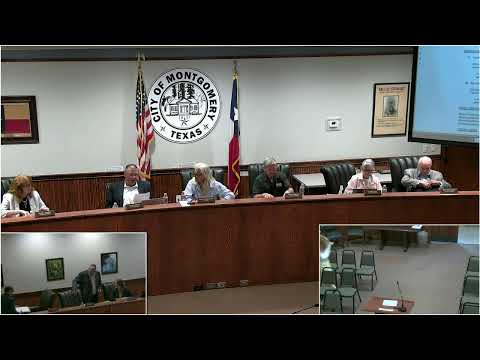
The City Council of Montgomery, Texas, voted July 15 to set a public hearing Aug. 26 at 6 p.m. at City Hall on proposed updates to the city’s water and wastewater impact fees, staff said. The action calls a hearing on revised land-use assumptions and an impact-fee schedule prepared to reflect a projected 10‑year buildout and rising construction costs; staff said the updated analysis shows roughly a 17% increase in recoverable impact-fee amounts compared with the current fee schedule. City consulting staff said the update covers a 10‑year planning window that includes about 3,923 additional connections, with 1,754 of those already in active development agreements. The consulting presentation cited a roughly $51 million capital plan over 10 years—about $26 million for water projects and $24 million for wastewater projects—and said an estimated $21 million of the water program appears “recoverable” in the impact‑fee calculation under state law. Staff noted state law limits how much of a project’s cost can be attributed to growth and recovered through impact fees. Council discussion focused on how the recoverable numbers relate to connection fees and other revenue sources. One councilmember asked why the fee calculation showed about $21 million recoverable for water when connection-fee receipts were projected at approximately $18 million; staff responded that state law constrains the proportion of project costs that can be attributed to growth and that impact fees are one tool among others (debt, user fees, developer reimbursements) to pay for capacity-related projects. Staff said some projects listed in the packet are capacity increases (for example, upsizing pumps) while other costs—such as routine plant rehabilitation that does not expand capacity—are not eligible to be counted as growth-related. Staff said the packet includes an objective summary of changes and supporting exhibits and that the written public‑notice in the council packet incorrectly listed a September hearing date; staff corrected it on the record to Aug. 26 at 6 p.m. No final fee figures were adopted at the July 15 meeting; the council’s action only set the public hearing. Staff said new state legislation taking effect Sept. 1 will change the frequency with which impact fees must be reviewed (once every three years under the cited changes), which informed the timing of the current update. Councilmembers asked for additional detail at the next hearing on projected total connections at full buildout, the schedule for major projects, and the funding mix expected to cover the non‑recoverable share of capital expenditures. If adopted after the required notices and public hearing, the revised impact fees would apply to new development within the city’s defined impact-fee service area.