Get Full Government Meeting Transcripts, Videos, & Alerts Forever!
Get email alerts on the Sustainability Plan topic
No spam. Unsubscribe anytime.
Council reviews revised Decorah Sustainability Plan; directs clarifications on stormwater fee, water monitoring, outreach and transportation data
Summary
The council spent extended time reviewing the Sustainability Commission’s revised 2025 plan and instructed commissioners and staff to refine actions on stormwater fees, water‑quality monitoring, communications, transportation data, EV chargers and curbside recycling.
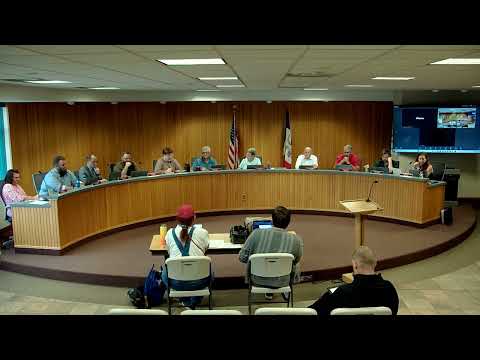
The Decorah City Council reviewed a revised 2025 Sustainability Plan recommended by the Sustainability Commission and provided commissioners and staff with detailed feedback across multiple sections.
Highest‑priority themes raised by councilmembers included: restructuring the stormwater utility fee to better reflect impervious surface and to incentivize on‑site stormwater practices; adding or clarifying water‑quality monitoring and an outreach plan to address rising nitrate concerns and upstream impacts; and clarifying municipal carbon‑neutrality commitments and the planning needed to make them actionable.
Selected discussion points and staff responses: - Stormwater fee: Several councilmembers urged elevating the stormwater fee study to a higher priority. They discussed shifting from a flat fee to an assessment based on impervious area or equivalent residential units (ERUs) so fees reflect contributions to runoff and could create discounts for property owners who reduce runoff. - Water quality monitoring: Councilmembers asked that the plan include an action to coordinate with county and state agencies on upstream nitrate trends and consider outreach to agricultural and watershed partners. - Carbon neutrality target: The plan includes a municipal government carbon neutrality goal for 2040. Councilmembers requested clearer baselines and an action plan so future budget and procurement decisions can be judged against the goal. - Communications and staffing: Council discussed whether the plan’s proposed communications role should be paid staff, intern, or coordinated through partners like Luther College or the library; concerns included budget constraints and staff capacity. - Issue reporting/online tracking: Several members cautioned that a city‑run online issue reporting app could increase staff workload and generate many low‑value reports; alternatives proposed included better publicizing an existing contact email or using interns/volunteers to help with outreach. - Volunteer coordination: Members discussed leveraging RSVP and other local organizations rather than the city assuming full volunteer‑coordination duties; council requested clarification that “city manager” in plan language refers broadly to city staff and not to a single staff person. - Transportation priorities: Councilmembers asked the Sustainability Commission to gather better mode‑share data (walk/bike vs. vehicle commute) before redirecting large budget shares. Sidewalk maintenance and winter clearing were discussed; several members said shifting full responsibility for sidewalks to the city would require new staff and funding. The council suggested researching pragmatic, low‑cost traffic‑calming and pedestrianization pilots and asked staff to consult the police chief before finalizing enforcement‑oriented language. - EV charging: Staff reported prior operational issues with public chargers and ongoing vendor coordination; council asked for more time to confirm the current status before further action. - Waste and recycling: Councilmembers signaled support for studying municipal curbside recycling and municipalizing or coordinating countywide collection to improve participation and efficiency; staff noted county involvement would be important for economics and site logistics.
Next steps: Staff will return the council’s comments to the Sustainability Commission and ask commissioners to revise the plan text or prioritize items as directed; staff will solicit input from relevant departments (police, public works), county partners and commission subject‑matter experts where requested.