
Planning Commission recommends City Council adopt 2025 Service Area Plan after LAFCO review
Get AI-powered insights, summaries, and transcripts
Sign Up Free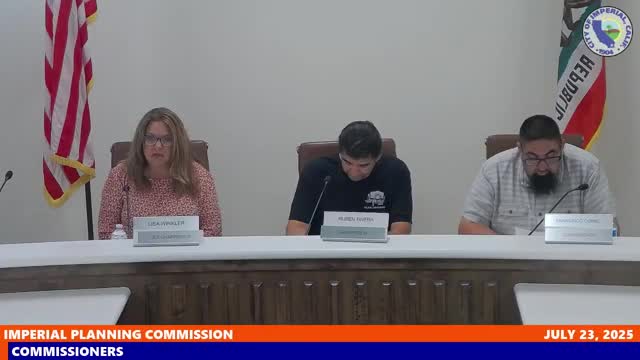
Summary
The City of Imperial Planning Commission voted 3-0 to recommend that the City Council adopt a 20-year 2025 Service Area Plan, a document LAFCO accepted that identifies infrastructure shortfalls, projected population growth and funding needs tied to future annexations.
The City of Imperial Planning Commission on July 23 voted 3-0 to recommend that the City Council approve the city’s 2025 Service Area Plan, a 20-year evaluation of the city’s capacity to serve existing development and projected growth through 2045. Staff presented the plan, saying, “The project is categorically exempt from the California Environmental Quality Act per section 15306, which consists of basic data collection, research, experimental management, and resource evaluation activities.” The presentation noted that the plan was prepared to inform future annexations and to satisfy requirements of the Cortese‑Knox‑Hertzberg Local Government Reorganization Act of 2000 for orderly growth and efficient service provision. The plan projects the city’s resident population to rise from 22,853 today to 43,061 by 2045, with a larger full build‑out estimate cited in the report. It identifies multiple service shortfalls that would need phased investment as annexations or new development occur: an 8,754‑square‑foot shortfall in administrative space; a 3,322‑square‑foot shortfall in police facility space and a staffing shortfall of four police officers; a current parks shortfall of about 5 acres projected to grow to roughly 129.2 acres at full build‑out; and a wastewater‑treatment plant expected to reach capacity by 2045. The presentation also said water supply is adequate for the near term but will require upgrades to serve future growth. On the city’s finances, staff reported a general fund balance of about $10.3 million, a water‑related net position of about $4.7 million, a sewer‑related net position of about $15.8 million, combined utility cash and investments near $22.9 million and approximately $28.9 million in utility‑related bonded debt. The report listed a net pension liability of roughly $5.7 million. Staff emphasized that the city intends to rely on impact fees, community facilities districts (CFDs), user rates and grants to fund needed improvements, and that future annexations should be conditioned on demonstrating service capacity and fiscal sustainability. The report recommended adding detailed fiscal‑impact and financing plans to any proposed annexation packages. Commissioners discussed the plan’s role as a snapshot in time and acknowledged that conditions and needs can change quickly. Commissioners asked about public safety services and noted the city is negotiating or renewing a contract with county fire and that ambulance response and AMR’s stationing strategy affect local emergency response times; staff cited the report’s response‑time notes of three to five minutes for medical emergencies and four to seven minutes for structure fires. Commissioners also discussed a recent mutual‑aid memorandum of understanding for fire services and ongoing efforts to acquire or refurbish fire engines to address equipment backlogs. During the discussion, commissioners repeatedly cautioned that the plan reflects the data available when it was prepared and that future annexation proposals may include updated fiscal details. Planning Commission staff said LAFCO held a public meeting on June 26, 2025, reviewed the submitted plan and accepted the determinations and exemptions noted in the report. A commissioner moved to recommend City Council approval of Resolution PC 2025‑10, adopting the 2025 Service Area Plan as prepared for the City of Imperial; another commissioner seconded. The motion passed on a 3‑0 vote. The Planning Commission’s action is a recommendation to the City Council; formal adoption by the council and any related annexation decisions remain separate actions. Background: the service area plan covers eight major service areas, including administrative facilities, drainage, police and fire, library, parks, circulation, water and wastewater. Staff recommended increased public engagement tools — for example, dashboards and satisfaction surveys — to keep residents informed as the city grows.