Get Full Government Meeting Transcripts, Videos, & Alerts Forever!
Get email alerts on the Equity Workplan topic
No spam. Unsubscribe anytime.
Covington equity commission outlines 2026 work plan; council urges data, partnerships and budget requests
Summary
At a joint study session, the Equity, Cultural and Social Justice Commission presented a 2026 work plan focused on community celebration, outreach and aligning equity goals with the city's comprehensive plan. Council members urged the commission to gather data, pursue partnerships and submit budget requests for event funding and pilots.
At a joint study session of the Covington City Council and the Equity, Cultural and Social Justice Commission, members reviewed the commission's proposed work plan for 2026 and discussed steps for community outreach, data gathering and modest budget requests.
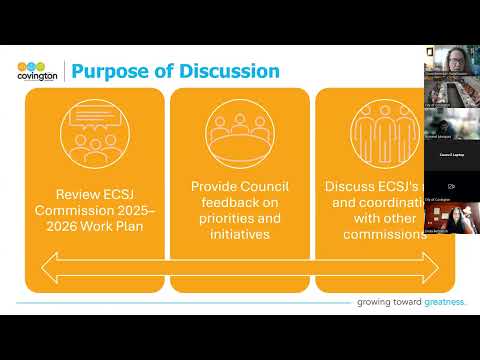
Janelle Johansson, a member of the Equity, Cultural and Social Justice Commission, presented the work plan and said its purpose was "to go over this 2026 work plan for the council to provide some feedback on their priorities and the initiatives that we've put together." Johansson told council the commission has been meeting monthly on fourth Thursdays since regaining quorum and currently has seven of 13 positions filled as of the second quarter of 2025.
The commission's stated goals include promoting the commission's mission, celebrating cultural diversity in city events, facilitating community dialogue and serving as a liaison to the council. Specific proposals discussed included a pilot civic-education class called "Covington 101," integrating cultural holidays into city programming, activating city-owned properties for multicultural gatherings (for example at the town center), and exploring targeted support for diverse small businesses, including food-truck participation at events.
Council members and staff recommended several next steps the commission could take before asking for funding. Council member Sean Smith suggested the commission gather more demographic data and reach out to local nonprofits, churches, hospitals and school district resources to understand which communities are present and what languages or cultural needs exist. Smith also recommended using the Washington Tracking Network and other state data tools to get ZIP-code-level demographic splits.
Debbie Hertzotch, a council member, and others emphasized practical outreach: contacting local nonprofits such as the Covington Food Bank/Storehouse for informal indicators of cultural food needs, partnering with the Human Services Commission for joint booths at Covington Days, and inviting community organizations (for example the Kent Kiwanis Club, Rotary, Maple Valley Community Center and groups such as Kent Educators of Color) to advise on culturally relevant programming.
City planning and staff support were offered as implementation resources. City planner Taffy Hernandez and community development director Salina Lyons noted that commission members already have access to background materials from the recent comprehensive-plan update and associated housing needs assessment. Johansson said the commission intends to "take little pieces" of larger projects and roll out pilots over time; she cautioned that the Covington 101 pilot "is a big project," and the commission does not plan to launch it within the current year.
Council members also discussed funding and the budget calendar. City Manager Reagan Bolle and others advised that budget request materials (decision cards) are due in July and encouraged the commission to flag any items that would require funding, even if only as modest, prioritized asks. Mayor Jeff Wagner used a planting metaphor to urge steady progress: "you've got to start planting the seeds for things to grow," and encouraged the commission to provide rough cost estimates for proposed events or pilot programs so council can consider them during budget deliberations.
Council member Beth Orr raised accessibility and inclusion considerations, noting ADA and mobility issues as examples of potential barriers to participation. Members urged that outreach include verification of whether residents face physical or language barriers to accessing city services and events.
The session closed with several practical suggestions for near-term action: (1) staff to share existing comp-plan materials and housing assessment data with the commission; (2) the commission to identify specific outreach contacts (nonprofits, schools, cultural groups) and to prioritize a short list of programs that may need modest funding; (3) the commission to submit any budget requests or rough cost estimates to staff in time for the July decision-card deadline; and (4) continued coordination with the Human Services Commission for shared event staffing or sponsorship opportunities.
No formal votes or ordinances were taken during the joint study session. The commission will continue monthly meetings (fourth Thursdays) and return with prioritized proposals and any budget requests for council consideration.