Get Full Government Meeting Transcripts, Videos, & Alerts Forever!
Get email alerts on the Wildlife Management Deer topic
No spam. Unsubscribe anytime.
Land Bank opens discussion on high deer numbers, seeks state guidance
Summary
Commissioners discussed an islandwide deer overpopulation problem, possible management steps including expanded hunting and a mobile deer-processing unit, and agreed to invite the state deer biologist to brief the commission on damage permits and options.
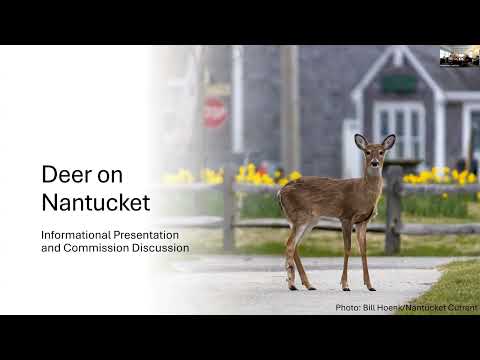
The Land Bank Commission discussed deer overpopulation and potential management approaches at its July 22 meeting, and staff said they will invite the state deer biologist to brief the commission on options and permitting.
A presenter for the Land Bank summarized the state’s population estimate, saying “there is a state estimate of more than 10,000” deer on the island and that roughly half the island is open to hunting. The presenter said fawn survival on Nantucket is unusually high — the presenter gave a figure near 95 percent — compared with about 30 percent off-island, and that the island lacks natural predators.
The presenter reviewed community feedback gathered by staff and commissioners: complaints from homeowners about garden and landscape damage, reports of injured or starving deer, safety concerns during hunting season, and requests to make some properties closed to hunting. The presenter cited the state’s plan to allow a month-long primitive arms season in January, and described MassWildlife’s Share the Harvest program, which facilitates processing and donation of deer meat; staff said that program distributed several thousand meals on Nantucket last year through processed deer donations.
Commissioners and members of the public weighed in on management options discussed at the meeting. Suggestions included improving disposal of gut piles, lowering logistical barriers that limit hunters from donating meat, using a mobile processing unit or a permanent processing facility to increase donated meat for food pantries, and exploring deer damage permits that can allow control methods on certain lands outside of the standard hunting season.
A staff member said sterilization and large-scale round-ups have been discussed in other settings but were described as impractical or unlikely to gain approval: “it would take, you'd have to sterilize too many deer. It would be too expensive,” the presenter said. The presenter also said damage-permit options can include baiting and other control methods tailored to a site.
Action items: staff and commissioners agreed to invite Martin Feeney, the state deer biologist, to present on deer damage permits and permit options; staff will also explore cost estimates for a mobile processing unit and possible partnerships with community groups that have expressed interest in sharing costs and freezer capacity. No formal vote to change land-use or hunting access was taken at the meeting.
Ending: commissioners asked staff to return with details after the briefing from the state biologist, and staff said any next steps would be presented as proposals for commission approval.