Get Full Government Meeting Transcripts, Videos, & Alerts Forever!
Get email alerts on the Mobile Food Units topic
No spam. Unsubscribe anytime.
Covington council adopts broader rules to allow mobile food vendors citywide
Summary
The Covington City Council passed an ordinance amending Chapter 5.3 of the Covington Municipal Code to expand where and how mobile food units may operate, formalize short-duration exemptions, set a $274 permit fee for ongoing vendors and require staff implementation steps.
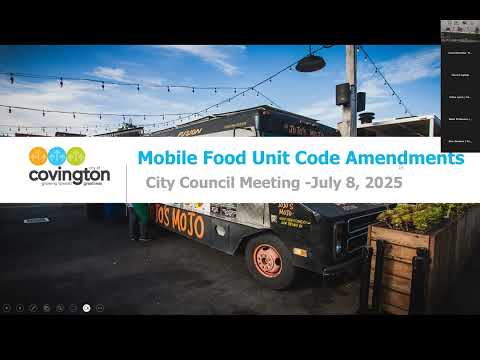
The Covington City Council on July 8 approved an ordinance amending Chapter 5.3 of the Covington Municipal Code to update how mobile food units (food trucks and similar vendors) are permitted to operate in the city.
Selena, a city planning staff member, told council the changes came after the Planning Commission’s 2024 review and are intended primarily to clarify zoning and reduce barriers for small food vendors. “Our role really isn't that level of regulation. It's really about the zoning and where you want to allow them in your city,” Selena said, describing the city’s focus on location and permitting rather than state health and safety enforcement.
Council members and staff said the ordinance keeps short-term, private and city-sponsored exemptions while creating a clearer permit path for recurring or longer-term vendors. The code defines exempt short-term or temporary operations as those lasting 6 hours or less in any 24-hour period; recurring or ongoing activity on private property now requires a mobile food unit permit or a right-of-way use permit if in the public right-of-way. City-sponsored events remain exempt under the drafted language.
The ordinance also includes operational limits and safety-aligned requirements drawn from state guidance: mobile food units cannot be used as habitable space, vendors may not leave vehicles parked on public streets for more than 24 hours, and operators must hold the applicable state and county food-safety permits before city permitting. Selena said other agencies — including the Department of Labor and Industries and King County Public Health — handle food-safety and licensing compliance before vendors seek city approval.
Council members asked staff about practical details. Selena confirmed the city will require a discrete list of documents for the mobile food unit permit and intends to streamline internal review. “The mobile food vendor is $274, so it's 2 hours of staff time,” Selena said when asked about fees. Council members also discussed enforcement: short-duration pop-ups will generally be exempt unless complaints trigger code-compliance checks, while recurring operations on private property will be reviewed under permit conditions.
Several members said the city should promote permitted vendors beyond a simple social-media notice. “I like the idea about the promotion. I think, a little more than social media,” said Sean, a council member, encouraging broader outreach if the program grows. Councilmember Beth, who seconded the motion to adopt the ordinance, praised the Planning Commission’s work to remove unintended barriers.
The council approved the ordinance by voice vote. Following the vote, staff said they will finalize permit forms and web guidance, coordinate outreach through the city communications team, and monitor complaints and compliance data to consider future adjustments (for example, specific hours of operation tied to the city's noise ordinance).
Implementation steps noted during the meeting included updating application forms, creating a clear web page describing permit types and exemptions, and coordinating social-media or other promotion. Staff also said they will revisit fee and operational specifics as the program develops and if enforcement data indicate changes are needed.
The ordinance expands citywide access for mobile food units while preserving exemptions for brief private events and city-sponsored activities, setting an initial administrative fee and asking staff to implement clearer permitting and outreach processes.