Get Full Government Meeting Transcripts, Videos, & Alerts Forever!
Get email alerts on the Pedestrian Bicycle Plan topic
No spam. Unsubscribe anytime.
Covington reviews final pedestrian and bicycle (nonmotorized) plan; staff to return with climate element next year
Summary
City staff and consultants presented a final pedestrian-bicycle (nonmotorized) plan on July 22, outlining short-, mid- and long-range projects, estimated multimodal costs, a projected 3.5% VMT reduction from short-term projects, and a plan to adopt the document as an appendix to the city's climate/comprehensive plan next year.
Covington City Council received a presentation on July 22 of the final Covington pedestrian and bicycle system plan, also described in the meeting as the city's nonmotorized or multimodal plan, which maps short-, mid- and long-range walking and bicycling projects, funding approaches and next steps for adoption.
The plan matters because it helps the city meet regional and state multimodal planning expectations and will guide future capital decisions, staff said. "We received a $410,000 grant from Commerce to do our climate action work, and we took about $170,000 of that and put it towards this plan," Selena, a city staff presenter, told council members during the study session.
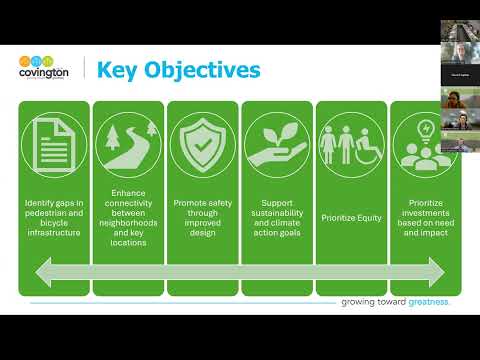
The plan identifies gaps in sidewalks, bike lanes, multiuse trails and pedestrian-level street lighting; prioritizes projects by short (1'06 years), mid (6'015 years) and long range timeframes; and overlays data from a citywide public engagement map. Short-range projects concentrate on higher-density corridors and routes serving schools and critical services. Mid-range items focus on infill and multiuse paths; long-range work completes the network to a stated goal of roughly 100% connectivity.
City staff and the consulting team from David Evans and Associates (DEA) described the financial and technical framing used to develop priorities. The presentation said the multimodal components embedded in the city's capital program total about $125 million; the consultant clarified this figure is the multimodal portion of projects already in planning, not $125 million of entirely new line items. The slide deck shown to council listed roughly $21.3 million of short-range projects and about $78.5 million classified as mid-range work. A Jenkins Creek Trail project was cited as an immediate connector already carried in capital plans.
Consultants estimated that the short-term projects in the plan would yield roughly a 3.5% reduction in vehicle miles traveled (VMT) per capita, a metric the Growth Management Act and regional planning bodies increasingly use to measure multimodal progress. The presentation said the plan draws on federal findings, including the Federal Highway Administration's nonmotorized pilot program, and aligns with guidance from the Puget Sound Regional Council (PSRC).
Council members pressed staff on affordability and timing. Several members expressed skepticism about the mid-range cost total and whether the city could realistically secure funding for the projects within the stated timeframe; staff responded that the plan is a tool to prioritize projects when grant or capital dollars become available and that priorities can shift if external conditions change (for example, added transit service). Staff also noted many projects overlap existing Transportation Improvement Program (TIP) and PROS (parks, recreation and open space) plan projects, meaning the listed multimodal costs reflect added multimodal elements rather than wholly new capital programs.
Staff described the plan's use of community input: a public interactive map and stakeholder interviews that flagged areas with deficient lighting, missing sidewalks and other barriers. The presentation highlighted equity as a lens for selecting projects to serve seniors, children and other vulnerable populations.
On implementation, presenters said the plan will support future grant competitiveness, inform an upcoming update to impact fees and serve as an appendix to the city's comprehensive plan and climate element. "This will come back to you all probably in early next year. You'll adopt it as a appendices to those comprehensive plan updates that we're gonna be bringing back as part of climate," Selena said at the meeting.
No formal motions or votes on the plan were recorded at the study session. Staff indicated they will return with the final climate element and the plan appended for formal consideration and adoption in the coming months.
The council thanked the consulting team and staff for the presentation and discussion; staff will use the plan as a decision tool to pursue grant opportunities, coordinate with partners (including neighboring cities and King County Metro if transit service changes) and refine project lists as funding and conditions evolve.