Get Full Government Meeting Transcripts, Videos, & Alerts Forever!
Get email alerts on the Senior Home Repairs topic
No spam. Unsubscribe anytime.
Baltimore council committee hears that home‑repair programs for older adults face long waits, staffing and contractor constraints
Summary
Baltimore City Council members, city housing officials, nonprofit partners and older residents met for an informational hearing on home‑repair assistance programs for older adults, where witnesses described long wait lists and operational bottlenecks that are delaying repairs meant to keep seniors safe and in their homes.
Baltimore City Council members, city housing officials, nonprofit partners and older residents met for an informational hearing on home‑repair assistance programs for older adults, where witnesses described long wait lists and operational bottlenecks that are delaying repairs meant to keep seniors safe and in their homes.
Councilman John Bullock, chair of the Education, Youth and Older Adults Committee, opened the hearing explaining that the session would update the council on city and partner efforts and invited the Department of Housing and Community Development and the Mayor’s Office to report on progress. Councilwoman Odette Ramos, sponsor of the hearing, said the council “wants to be partners to make sure that all of our older adults can age in place with dignity.”
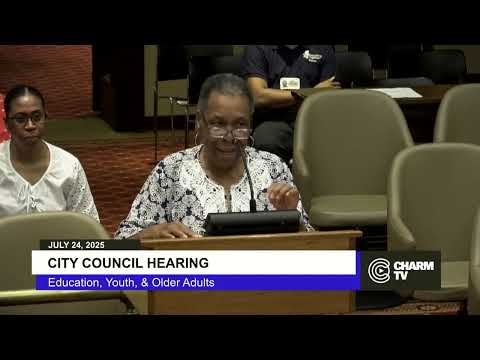
The hearing brought several older residents to testify about delays. Cecilia Alexander, a senior resident, told the panel that “When you're dealing with a vulnerable population, time is just not precious. It's critical,” and described a months‑long intake delay and difficulty getting a consistent caseworker. Resident Quentin Whaley described years of attempts to secure roof and electrical work, saying he had been “on the line with these same public people for over 4 years” and that after an initial contractor intervention his roof failed again.
City and partner testimony: structure, funding and constraints
Alice Kennedy, Commissioner of the Baltimore City Department of Housing and Community Development (DHCD), described the city’s intake and delivery structure. DHCD’s “light” intake and assessment unit handles pre‑applications and document collection and refers eligible homeowners to the Office of Rehabilitation Services (ORS) or partner programs for construction. Kennedy said the office triages “priority emergency cases where there is immediate threat to health, life, and safety,” but emphasized that the overall workflow—from pre‑application to invoice—can take many months and “there are components of this process that we at the city don't control,” including contractor availability and permitting.
Andoria Harmon, Director of the Mayor’s Office of Older Adult Affairs and Advocacy, said she is preparing a citywide aging plan but warned that “If you want me to produce a plan, then when that plan is produced, make sure in order to make Baltimore City a age friendly city, that you back it up with funding.”
HUBS nonprofit partners said the joint model is effective but understaffed. Lauren Averella of CivicWorks, an administrator of the Housing Upgrades to Benefit Seniors (HUBS) collaborative, said the program uses a “no‑wrong‑door” intake model and that HUBS partners have helped more than 3,500 older adults remain in their homes, focusing on roofing, HVAC, plumbing, electrical work and accessibility modifications. But Averella and others said staffing is the bottleneck: CivicWorks currently assigns clients to six case managers (one per ZIP‑based caseload) and is operating a cohort model; at the present pace the HUBS partners complete about 450 cases a year.
Bonnie Besser, executive director of Rebuilding Together Baltimore, and Colin Choney of Green and Healthy Homes Initiative (GHHI) told the committee that contractors are less willing to work with the program because of prior payment delays and permitting hurdles. Besser said many payment timing issues have been resolved but that “the damage that has been done in relationship with contractors persists, because they are no longer interested in working with the city.”
Funding already used and operational needs
Commissioner Kennedy detailed recent funding sources the city has used for older‑adult home repair: nearly $2.5 million from the Affordable Housing Trust Fund to HUBS partners in the last three years (subject to AMI income limits), and roughly $4.8 million of ARPA funds dedicated to older adult repair (55+) that have been spent to date. She said DHCD also uses Community Development Block Grant (CDBG) funds for operations and that various CIP line items support the work.
Partners and city staff said capital funding alone is insufficient without more case managers, intake staff and customer‑service support. CivicWorks and GHHI estimated that operating costs to scale services are material: CivicWorks gave an illustrative figure of about $4 million in operating funding to close immediate staffing gaps and enable more capital to be deployed faster, while partner testimony emphasized that operating funding equal to a significant share of capital (partners suggested roughly 20–30% as an illustrative proportion, depending on program design) would be needed to sustain higher throughput. Partners also noted that average repair costs have climbed (a decade‑old $10,000‑per‑house average now is commonly $20,000–$40,000), raising capital needs.
Wait‑list and capacity details
Witnesses and city staff provided multiple, overlapping wait‑list figures during the hearing: DHCD reported about 1,425 older‑adult clients on the “light” intake wait list who still need intake work and another 101 clients who have been fully screened and are waiting for ORS services; HUBS partners reported approximately 1,470 people on their wait list, of whom 889 had completed intake and were ready to be assigned to a case manager. CivicWorks and GHHI said current throughput (about 450 households per year) means it would take more than three years to serve the HUBS wait list at current capacity.
Operational changes and near‑term actions
DHCD said it is reorganizing to improve customer service and data tracking: the division added a director of administration to lead a customer‑service team, is recruiting three office support specialists and multiple social‑service coordinators (DHCD described plans for six social‑service coordinators plus supervisors on the light intake team), and is working with the city’s innovation and IT teams to improve wait‑list data and call tracking. DHCD also reported work with permit liaisons to reduce inspection delays and instructed HUBS partners how to self‑identify city‑funded projects in the Acela permitting system.
Partners said cohort scheduling, clearer prequalification for contractors and a uniform payment process would reduce delays and encourage more contractors to accept HUBS projects. Colin Choney said HUBS moved to a tri‑annual cohort model so case managers have manageable caseloads and can better track outcomes, but repeated that added operating staff is needed to shorten an average 18‑month wait he cited for clients who completed repairs in 2025.
Next steps and council direction
Council President Z. Cohen and others urged development of a citywide, funded strategic plan for aging in place that braids housing, health and philanthropic investments. Committee members requested follow‑up information on (1) exact project/account PRJ numbers and current expenditures in the capital budget that support home repair lines; (2) a clearer mapping of overlapping DHCD/HUBS wait lists; and (3) a costed proposal from HUBS and DHCD showing how incremental operating investments would increase annual throughput. Council staff said they would request the budget/PRJ detail and asked agencies and partners to return for a follow‑up hearing within months to report progress.
Ending
Committee members and witnesses characterized the HUBS network as an effective collaborative that needs more staffing, clearer intake technology and standardized contractor/payment practices so capital funds already committed can be deployed faster to households in immediate need. No formal action or vote took place at the informational hearing; the committee recessed after scheduling continued follow‑up and additional reporting.