Get Full Government Meeting Transcripts, Videos, & Alerts Forever!
Get email alerts on the Entity Regulation topic
No spam. Unsubscribe anytime.
WSBA Board of Governors approves fees for entity regulation pilot project
Summary
The Board of Governors approved a tiered fee schedule to fund a pilot allowing nonlawyer entities to provide legal services under court authorization; the vote passed with one abstention and one absence after members raised concerns about enforcement, monitoring and budget assumptions.
The Washington State Bar Association Board of Governors on an approval vote adopted a tiered fee schedule to fund a pilot project that will authorize certain entities to provide legal and law‑related services under court authorization. The motion to approve the fees as presented in the meeting materials passed, with one abstention and one absence.
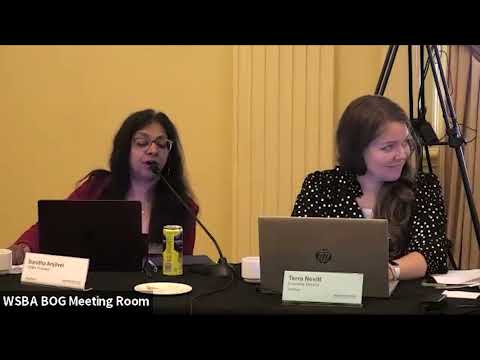
Chief Regulatory Counsel Hinata Garcia told the board the proposal sets a two‑tiered application fee — $2,000 for general entities and $1,000 for entities with an Access to Justice mission — and annual participation fees of $5,000 and $2,500 respectively. "We are proposing a tiered fee model," Garcia said, adding the schedule is designed to be revenue neutral and comparable to fees charged in Utah and Arizona.
The board’s vote follows discussion of the pilot’s assumptions, budget and oversight. Garcia said planners expect a modest number of applicants in year one (15), growth to about 35 in a following year, and an approval rate of about 80 percent in year one rising to about 85 percent thereafter. The program is budgeted to add one full‑time entity regulation staff position in the next fiscal year, Garcia said, and the office plans to hire a third party to handle initial investigation costs tied to application volume.
Why this matters: the pilot is the first time the Bar will consider licensing or authorizing entities — not only individual lawyers — to deliver legal services in Washington. Supporters say entity regulation could expand access to legal help and give the Bar tools for discipline and consumer protection that the current unauthorized‑practice framework does not provide.
Board members and section representatives raised concerns about enforcement capacity and whether the proposed fees and staffing are adequate. Nancy Hawkins, speaking for the Family Law Section, said the budgeted amounts underestimate investigation and monitoring needs and warned that underbudgeting could leave the program unable to police participating entities. "The budget is too low," Hawkins said, adding that monitoring after approval will be required and that line items for investigation and staff training appear insufficient in later years of the budget model.
Executive Director Navett emphasized the plan is intended to be paced with actual demand: if applications are few, the Bar may not fill the proposed FTE; if demand grows the Bar could return to the board to request additional budget. Navett and Garcia also noted that some monitoring work would fall to WSB A staff and that the court would issue the individual authorizations that define what each entity is permitted to do in Washington.
Several governors and former governors said public education and clear, objective eligibility criteria will be important incentives for voluntary participation. Former Governor Brent Williams described examples from trusts and estates where nonlawyers have stepped into legal roles and said consumers are being harmed; "The public is constantly being victimized in the world of trust and estates by financial advisers that are stepping outside their lane," Williams said.
Board deliberations briefly considered, but did not adopt at the time of the vote, staff suggestions to make fees nonrefundable, prorate annual fees for midyear entrants and set a February 1 payment deadline; the board ultimately returned the motion to the original recommendation and approved the fees as presented in the packet.
Next steps: Garcia said approval of the fee schedule allows the Bar to recommend the fees to the Supreme Court and proceed toward the project’s planned go‑live date. The project has a court mandate to begin implementation in October, Garcia said. The board’s vote authorizes recommending the fee schedule to the court and moves the pilot from planning toward implementation.