
Montgomery County committees review COA designation and proposed limits on coordinating entity’s program work
Get AI-powered insights, summaries, and transcripts
Subscribe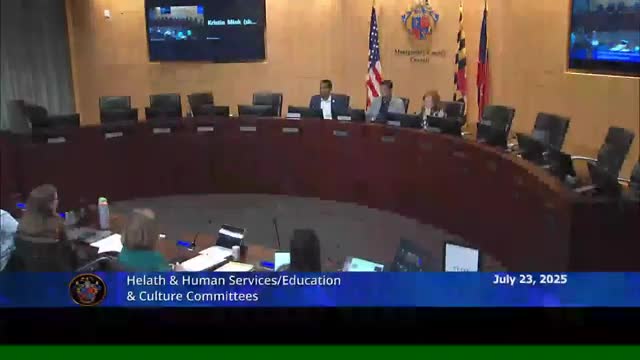
Summary
Montgomery County council committees met July 23 to review the Children’s Opportunity Alliance’s designation as the county’s early care and education coordinating entity and to debate proposed county code changes that would limit the entity’s ability to fund or contract for childcare services.
Montgomery County council members and staff met July 23 in a joint work session of the Education & Culture Committee and the Health and Human Services Committee to review the county’s early care and education coordinating entity designation and proposed amendments to county code that would limit what the coordinating entity can fund or directly provide. Committee members discussed two related county bills—Bill 11‑25 (child care coordination amendments) and expedited Bill 20‑325—plus a July proposal to extend the Children’s Opportunity Alliance’s (COA) designation through Dec. 31, 2025. No final votes were taken at the session.
The discussion centered on competing goals: keep the entity focused on system‑level planning and accountability, and preserve the flexibility to pilot programs and use philanthropic or county funds to fill local gaps. Council staff outlined that Bill 11‑25, introduced at the county executive’s request, would remove a now‑vacant “childcare and early education officer” position from county code and repeal provisions that assigned duties to the early childhood coordinating council because those duties have largely moved to COA. Expedited Bill 20‑325 would further clarify the coordinating entity’s duties and explicitly limit activities described in the existing statute, including a narrower definition of “direct services.”
County and COA staff described how the legal and practical definitions of “direct services” diverge. Michelle Gallipoli, an HHS planning specialist, and Mark Hodge, HHS chief operating officer, said HHS treats the delivery of services funded by county dollars — including grants and contracts that pay for seats or navigation work — as part of the county’s direct‑service footprint. Hodge said HHS is still deciding who will fill an ex‑officio seat that became vacant earlier in 2025 and that the department is coordinating internally about selecting a replacement.
COA leaders said the nonprofit has been carrying out system‑building work while also using limited private and public funds to pilot interventions that help providers access state pre‑K grants and help families navigate the system. “The state has given the county the opportunity to name who it wants to be the local ECAC and we have suggested that it will be the Children’s Opportunity Alliance common agenda steering committee and they have accepted that,” COA manager Laura Jeromey said, describing the office of the state superintendent’s recognition of COA as the local ECAC contact. COA’s executive director, Kimberly Rosnick, told the committees that COA’s pilots and grants were intended as midstream and upstream system work: training local partners, helping providers apply for state pre‑K funds and building data to inform advocacy.
COA reported several concrete outputs and funding figures. The organization said it spent about $30,000 in private funds in fiscal 2024 to support application assistance; it made four grants totaling $168,000 to build family‑childcare capacity through a competitive RFP; and it administered a $1,000,000 county allocation last fiscal year to support provider capacity building. COA reported that midway through its fiscal 2024 pilots, there were 354 state‑funded pre‑K seats in community‑based settings, which COA estimated translated into roughly $1.9 million in state funds entering the local system. COA also cited a local workforce study showing 11% of early childhood educators reported being on Medicaid, 37% received some public benefit and 16% reported having no health insurance.
HHS urged clearer statutory limits because the department said COA’s grant making and contracting have produced recurring operational questions about duplication of services and contract monitoring. "These refinements are both necessary and essential to strengthening the role of the early care and education coordinating entity," HHS senior administrator Jennifer Arnise wrote in a memo read into the record. Arnise and other HHS staff recommended adding measurable accountability metrics—progress on strategic priorities, stakeholder engagement, equity indicators and cross‑sector coordination—so the county can evaluate whether the coordinating entity is achieving system change.
Committee members and COA board members also discussed governance and participation. COA’s board is a large, mixed public‑private board with statutory composition requirements; COA said average meeting attendance has ranged from about 12 to 15 members and that some seats were vacant or had term expirations on June 30, 2025. COA described hiring equity coaches, forming board subcommittees, and planning elections for its executive committee later in the fall. Council members pressed HHS and COA on how many ex‑officio seats should be drawn from the same department, whether ex‑officio members should vote, and what assurances are appropriate if COA continues to contract or pilot services with public funds.
Council staff listed three designation options for the committee to consider later: (1) redesignate COA for the second three‑year period; (2) extend COA’s temporary designation until Dec. 31, 2025, while the council finishes statutory language; or (3) designate a different nonprofit (which would likely require a new solicitation and additional council and executive branch coordination). Council staff also recommended an Office of Legislative Oversight review to help develop metrics for evaluating the coordinating entity.
Members from both committees emphasized the “fierce urgency of now” — that members want pilots and capacity building done more quickly to expand seats and supports — while also stressing the need for clearer boundaries and accountability if COA will receive public funds or perform activities that closely resemble direct service. COA asked for more time to reach internal consensus on draft statutory amendments; COA’s board held an emergency meeting the night before the work session and did not reach agreement on every proposed change. The committees did not vote on any legislation at the session and planned to reconvene for further work sessions in the fall to refine statutory language, review any requested OLO analysis, and discuss next steps with HHS and COA.
For now, the three immediate procedural items on the agenda remain: Bill 11‑25 (child care coordination amendments), expedited Bill 20‑325 (early care and education coordinating entity), and the council resolution introduced July 8, 2025, to extend COA’s designation to Dec. 31, 2025. Committee members said they would aim to continue the discussion before the state legislative session and to produce clearer statutory language that balances COA’s role as a systems convener and accountability partner with the county’s responsibility for fiscal oversight and preventing duplication of direct services.