Get Full Government Meeting Transcripts, Videos, & Alerts Forever!
Get email alerts on the Payment In Lieu Of Taxes topic
No spam. Unsubscribe anytime.
Committee advances bill to expand automatic PILOTs to public housing authorities
Summary
A Montgomery County joint committee on July 24 unanimously recommended Bill 25-25 to the full council. The bill would expand automatic payments in lieu of taxes (PILOTs) to public housing authorities, clarify the definition of "authority," and add procedural language on regulatory agreements and transfers of buy‑right PILOTs.
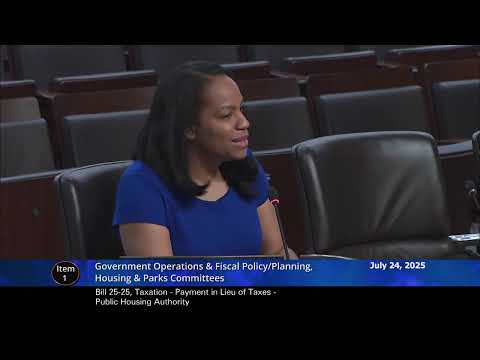
A Montgomery County joint committee of Government Operations & Fiscal Policy and Planning, Housing, and Parks on July 24 voted unanimously to recommend Bill 25-25, which would expand and clarify the county’s payment‑in‑lieu‑of‑taxes (PILOT) provisions to apply expressly to public housing authorities. The committee met in a joint session to review the measure after its June 17 introduction and a July 8 public hearing.
The bill, as described by council members and staff, would add a definition of “authority,” align county language with state housing code, extend the buy‑right or automatic PILOT that currently applies to the Housing Opportunities Commission (HOC) to other public housing authorities, and change certain procedural rules for executive regulations. Council staff told the committee the Office of Management and Budget’s fiscal impact statement anticipates no county expenditure or additional staffing if the bill is enacted.
Council Member Andrew Friedson, co‑chair of the joint committee, said the measure is intended to “clarify and expand” an earlier PILOT framework so nonprofit housing providers and other public housing authorities can access the same up‑front tax relief that HOC receives. Council Member Katz, lead sponsor of Bill 25‑25, thanked council staffer McCartney Greene for shepherding the draft and described the measure as meant to provide clarity so affordable‑housing providers can obtain financing and compete in the market.
Robert Love, manager of the Affordable Housing Section at the Montgomery County Department of Housing and Community Affairs (DHCA), provided transactional context. Love told the committee that for fiscal year 2025 the county recorded five new PILOT transactions — three by‑right buy‑right agreements and two standard agreements — plus three existing pilot properties. He summarized the 2024 tax bill totals for those new PILOTs as roughly $1,000,083.72 and the existing pilots as $657,429.
The committee discussed concerns raised during the public hearing about whether for‑profit owners could improperly benefit. Council staff and DHCA representatives said there was no matching pilot transaction in county records tied to the example raised at the public hearing. The committee also reviewed how existing ground‑lease arrangements and private market encumbrances interact with PILOTs; staff explained that the county bills the property owner on tax records and private contract terms such as ground rents are separate private agreements.
On the question of transfers, DHCA staff and counsel said a buy‑right PILOT is not automatically assignable to a new owner. If a property with a buy‑right PILOT is sold, the county will enter into a new buy‑right PILOT with the purchaser only if the purchaser accepts an assignment of the regulatory agreement or enters into a new regulatory agreement containing substantially the same terms and satisfying state and county eligibility requirements.
The committee adopted a technical amendment recommended by the Office of the County Attorney to align the bill’s definition of “authority” with the state housing code by removing an internal, nonstatutory phrasing. Committee members also asked DHCA and OCA to update the county’s PILOT regulations, which staff said have not been revised since 2021 (Bill 26‑21 was noted as a prior legislative milestone affecting the rules).
Committee members repeatedly framed the bill as an implementation and clarity effort rather than a change in county subsidy levels: the stated goal is to forego property tax revenue up front, under clear contractual terms, so affordable‑housing providers can secure financing and preserve or produce affordable units more efficiently than the prior approach of providing subsidies after taxation.
With the technical amendment adopted, the committee chair called for a vote; members raised their hands and the recommendation to the full council was unanimous. The measure now proceeds to the full Montgomery County Council for consideration.
The transcript shows the July 24 discussion opened with staff overview, included questions about implementation and transfers, and closed with the unanimous recommendation to the full council.